This is a rough outline syllabus for the class I am teaching this semester at the University of Notre Dame on the philosophy and logic of games.
University of Notre Dame Fall 2026
Philosophy and Logic of Games
Phil 20615
Joel David Hamkins, O’Hara Professor of Logic
TR 3:30—4:45am 110 O’Shaughnessy Hall
Description. Shall we have a game? The course will explore the philosophy and logic of games, exploring all things games. We shall begin with some elementary game theory and decision theory, investigating game-theoretic ideas in the context of numerous actual games, moving eventually to the fundamental theorem of finite games, game trees, the hypergame paradox, and more. Students will demonstrate playing mastery over a variety of familiar games, including chess, draughts, Nim, Hex, Othello, Connect 4, and others. The course will include philosophical readings on the nature of human game playing. The latter part of the course will delve into infinitary issues, including determinacy and nondeterminacy, connections with the philosophy of mathematics, Conway games, and the surreal numbers as games. It will be a highlight of the class to cover the analysis of various infinite games, including infinite chess, infinite draughts, infinite Hex, infinite Wordle, infinite Sudoku, and more.
Fulfills University 2nd Philosophy Requirement. The University of Notre Dame is unique to my knowledge in requiring all undergraduate students, regardless of major, to take two philosophy classes. (And this situation is surely part of the explanation for both the large size and high quality of the Notre Dame philosophy department.) At many other universities, including those at which I previously worked, this would entail that there was a contentious argued but finally standard Phil 1 and Phil 2 class syllabus, which all students took exactly alike. But the Notre Dame style is rather to have a free market in intro and 2nd philosophy classes, and students can choose the one they like. This games class happens to fulfill the 2nd philosophy requirement. The class is open to all students, with no prerequisites, and the class is full of students with diverse majors, including engineering, computer science, neuroscience, finance, and others. But most of the students have a STEM or math angle in their major, since this is the population attracted to the class.
Readings will be based on selections from:
- Joel David Hamkins, Infinite Games: Frivolities of the Gods, selected readings available for students on https://infinitelymore.xyz.
- Bernard Suits, “What is a Game?” Philosophy of Science , Jun., 1967, Vol. 34, No. 2 (Jun., 1967), pp. 148-156. Available at: https://www.jstor.org/stable/pdf/186102.pdf
- Thi Nguyen, Games: Agency as Art, 2020, Oxford University Press.
- Thi Nguyen, The Score, 2026, Penguin Random House.
Each lecture will be on a topic assigned from the reading, with several homework questions and topic assigned. A detailed schedule of topics and readings will be made available.
In-class writing quizzes. We will have a number of in-class quizzes, especially on the readings as well as the more theoretical material. Students are advised to stay on top of the reading and to be prepared to explain the finer points of the ideas we discuss and read about.
Class participation. Students should expect to participate in the class discussion. Every student should aim to participate in every lecture with comments or questions. I will be calling on students in class for contributions.
Game challenges. Students will demonstrate playing mastery over a variety of familiar games, including chess, draughts, Nim, the Gold Coin game, Hex, Othello, Go, Connect 4, Rubik’s cube, and others, undertaking scheduled game play with the professor. Students should plan to practice thoroughly before undertaking the challenge. Assessment will be based on proficiency and strategic reasoning, as well as the ability to speak sensibly with the professor about relevant general strategic considerations and principles while playing the game and afterward. Games challenges can be scheduled using the Google scheduler form. I will make additional slots available as the semester progresses if there is need.
Philosophy Games Club. Students are encouraged to participate in the Philosophy Games Club, which I have organized in the interest of this course. The club meets in the philosophy lounge (first floor of Malloy Hall) every Thursday afternoon 1:30-3, with members of the broader philosophical community invited, including especially all students in this class. Free snacks and refreshments will be provided. Students will have a chance to learn some of the games and play each other, as well as the professor.
Use of AI. The various AI and generative text tools are certainly powerful, and some students may find this to be a useful way to learn interactively about a topic, as with a substitute artificial study partner (although it is better to have an actual human study partner). My policy is that students must not submit AI-generated work as their own, including work resulting from AI editing tools.
Grading Assessment. The final course grade will be based on the in-class quizzes, covering the abstract theoretical and philosophical material, the games challenges, class participation, and a final exam, which will cover the entire course. The class will be highly interactive, and students should come prepared to contribute meaningfully.
- In-class writing quizzes, 5 points each
- Games challenges, 5 points each.
- Final exam, 30 points
- Class participation and discussion contributions, 10 points
Grading is not based on a rigid translation of scores to letter grades, but rather will take account of the difficulty of the challenges and materials. “On the curve”
Mathematical prerequisite? There is no official mathematical prerequisite, but students should expect to get involved with some detailed or technical arguments in the theory of games in a manner that is similar to mathematical argument. In this sense, openness to a mathematical outlook will be invaluable.
Lecture topics, tentative
- First day. Game of 15. Twenty-One. Also, if time, the Monty Hall problem.
- Finding Fifteen (on Infinitely More)
- Twenty One
- Chocolate bar puzzle, Chomp
- Nim
- The game of Nim on Infinitely More
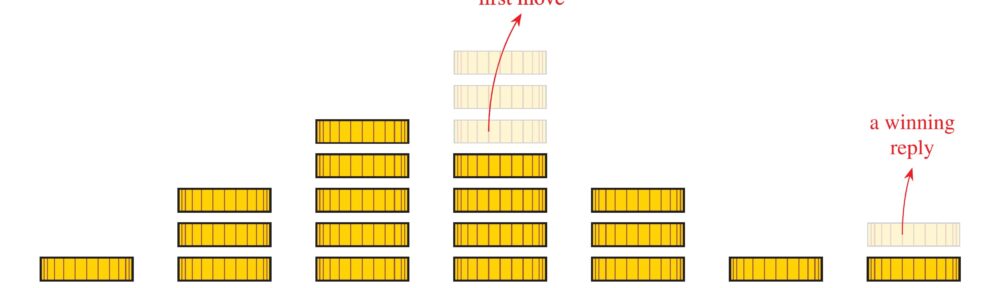
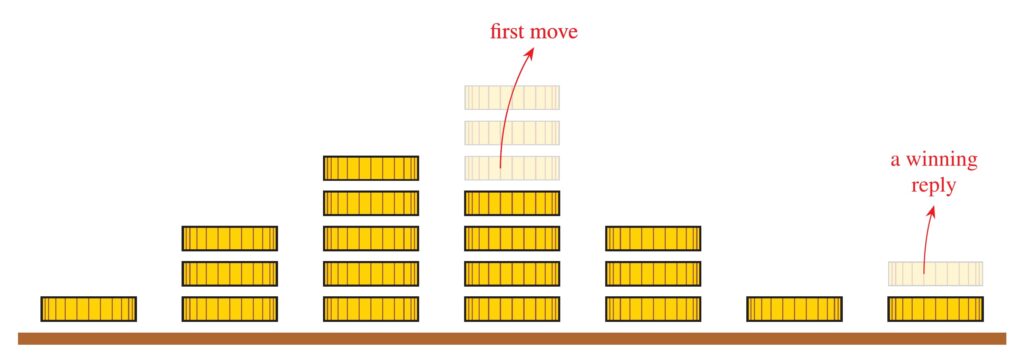
- The Gold Coin game
- The Gold coin game on Infinitely More
- What is a game? Please read the reading in advance and come prepared for philosophical discussion.
- Bernard Suits, “What is a Game?” Philosophy of Science , Jun., 1967, Vol. 34, No. 2 (Jun., 1967), pp. 148-156. Available at: https://www.jstor.org/stable/pdf/186102.pdf
- Tic tac toe variations (2 lectures)
- David Galvin, 4×4 Tic-Tac-Toe is a Draw
- Tic tac toe and variations, on Infinitely More
- 3D tic tac toe has no draws
- Infinite tic tac toe
- The penny-partition paradox
- Penny-partition paradox, on Infinitely More
- Prisoner’s dilemma
- Jason Wyckoff, “The Prisoner’s Dilemma,” 1000 Word Philosophy, 2014. https://1000wordphilosophy.com/2014/04/24/the-prisoners-dilemma/
- Escape!
- The Escape! game, selection from Proof and the Art of Mathematics, via Infinitely More
- Finite and transfinite variations of Escape! on Infinitely More
- Buckets of Fish
- Buckets of Fish! on Infinitely More
- Thi Nguyen, Agency as Art, selections:
- Chapter 1
- Chapter 10
- Afterword
- Whatever more of the text you can read will benefit the discussion.
- Chess
- Guest lecture on chess (this will take place October 1, 2026)
- Random chess position on Infinitely More
- Recursive chess on Infinitely More
- Hypergame paradox + Game trees
- The hypergame paradox, on Infinitely More (this essay includes an introduction to game trees)
- Fundamental theorem of finite games
- The Fundamental theorem of finite games, on Infinitely More
- This topic will span several lectures, and will be a core topic of the class
- On going first
- On going first on Infinitely More
- Tactics versus strategies in the theory of games
- Tactics versus strategies in the theory of games on Infinitely More
- The tactical variation of the fundamental theorem on Infinitely More
- Tactics versus strategies—the case of chess on Infinitely More
- Thi Nguyen, The Score, selected chapters
- Supertask
- Supertasks, from The Book of Infinity, via Infinitely More
- ERGO lecture: Supertasks: Doing infinitely many things
- The Chocolatier’s game
- The Chocolatier’s game, via Infinitely More
- A few sequence games
- Face Up, on Infinitely More
- Bubble monsters, coming soon on Infinitely More
- Pushpast and Pushthrough
- Introduction to the transfinite ordinals
- How to count, from The Book of Infinity, via Infinitely More
- How to count to infinity and beyond, YouTube video
- Subway paradox
- The infinite subway paradox on Infinitely More
- The infinite subway—a full range of paradox on Infinitely More
- The infinite subway—extending into the transfinite on Infinitely More
- The uncountable transfinite subway on Infinitely More
- Introduction to infinite games
- Infinite Connect Four on Infinitely More
- Infinite Sudoku on Infinitely More
- Infinite Nim, Infinite draughts, infinite chess, infinite Hex, infinite Wordle.
- This lecture will be based on my talk for the Infinite Games Workshop. Slides are available at Introduction to Infinite Games, with video on YouTube.
- See also, Strategic Thinking in Infinite Games, which are the slides from a talk I had given in 2023 at the CosmoCaixa Science Museum in Barcelona
- Infinite Wordle, Infinite Mastermind,
- Infinite Hex,
- Infinite chess,
- Infinite draughts (checkers)
- Hat puzzles
- Infinite hat puzzles and the Aftermath, from The Book of Infinity, via Infinitely More
- Epistemic logic
- Epistemic logic and the problem of common knowledge on Infinitely More
- Pirate-treasure division, Philosopher’s ruling council, Blue-eyed islanders.