Skip to primary content
Skip to secondary content

Joel David Hamkins

mathematics and philosophy of the infinite

Joel David Hamkins

Main menu

  • Home
    • About
    • My Curriculum Vita
    • Contact
    • Comment Board
  • Publications
    • Publication list
    • Recent publications
    • Publications by topic
      • Automorphism towers
      • Infinitary computability
      • Infinitary utilitarianism
      • Large cardinals
    • My Research Collaborators
  • Talks
    • Talks
    • Recent and Upcoming Talks
    • Videos
  • Appointments and Grants
    • About Me
    • My Academic Appointments
    • Grants and Awards
  • Teaching
    • About My Courses
  • Students
    • About My Graduate Students
    • List of My Graduate Students
  • Mathematical Shorts
  • Math for Kids

Tag Archives: Mindscape

Puzzles of reality and infinity, Mindscape Podcast

Posted on July 15, 2024 by Joel David Hamkins
Reply

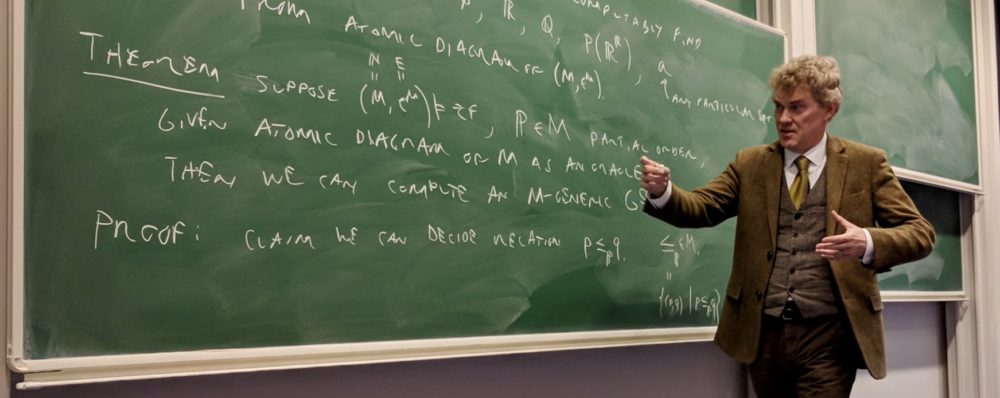
I was interviewed by Sean Carroll for his Mindscape Podcast, broadcast 15 July 2024.

282 | Joel David Hamkins on Puzzles of Reality and Infinity

Share:

  • Share on X (Opens in new window) X
  • Share on Facebook (Opens in new window) Facebook
  • Share on Reddit (Opens in new window) Reddit
  • Share on WhatsApp (Opens in new window) WhatsApp
  • Email a link to a friend (Opens in new window) Email
  • Print (Opens in new window) Print
  • More
  • Share on LinkedIn (Opens in new window) LinkedIn
  • Share on Tumblr (Opens in new window) Tumblr
  • Share on Pinterest (Opens in new window) Pinterest
Posted in Talks, Videos | Tagged Gödel, incompleteness, Mindscape, multiverse, philosophy of mathematics, Sean Carroll | Leave a reply

Infinitely More

Proof and the Art of Mathematics, MIT Press, 2020

Buy Me a Coffee

Recent Comments

  • WeightConvert on Infinite Sudoku and the Sudoku game
  • BodaciousTattvas on Set-theoretic mereology as a foundation of mathematics? Shandong University, Workshop on Mereology, China, June 2026
  • Joel David Hamkins on Set-theoretic mereology as a foundation of mathematics? Shandong University, Workshop on Mereology, China, June 2026
  • BodaciousTattvas on Set-theoretic mereology as a foundation of mathematics? Shandong University, Workshop on Mereology, China, June 2026
  • William on Set-theoretic mereology as a foundation of mathematics? Shandong University, Workshop on Mereology, China, June 2026

JDH on Twitter

My Tweets

RSS Mathoverflow activity

  • Answer by Joel David Hamkins for A question relating to the measurability of cardinals
    The principle is wrong and there are two main kinds of counterexamples. First, there are large cardinal notions that imply the existence of certain smaller large cardinals, including measurable cardinals, which do not themselves exhibit the property. For example: If there is a Woodin cardinal, then there are many measurable cardinals, but not every Woodin […]
  • Comment by Joel David Hamkins on A question relating to the measurability of cardinals
    Another kind of counterexample would be to take $A$ and $B$ as both very weak notions, but $\lambda$ happens to be measurable and $\kappa$ not measurable. For example, let $A(x)$ be "$x$ is Mahlo" and $B(x)$ is "$x$ is inaccessible. Now let $\kappa$ be the first Mahlo cardinal and let $\lambda$ be a measurable cardinal.
  • Comment by Joel David Hamkins on Confusion regarding the requirements for a recursive ordinal notation
    @AndreasBlass Right, I think we are in agreement. In my experience, these days when people say "computable ordinal" they just mean that the order relation is computable, but when people talk about a "denotation system" they probably want more. Meanwhile, I take the constructions I described to show (1) one may always have the extra […]
  • Comment by Joel David Hamkins on Confusion regarding the requirements for a recursive ordinal notation
    By multiplying by $\omega^2$ or more, one can also make the "next limit" operation computable, and much more.
  • Comment by Joel David Hamkins on Confusion regarding the requirements for a recursive ordinal notation
    @AndreasBlass In terms of which ordinals are represented, those requirements give the same ordinals. If I have a computable well-ordered relation, after all, I can make a computable relation with your properties simply by muliplying it by omega, adding a new $\omega$ chain above each point. In the new order, limits and successors are also […]
  • Answer by Joel David Hamkins for Countinuous "refinement" of a function $f : [\omega]^\omega \to [\omega]^\omega$
    I guess the metric space you have in mind for $[\omega]^\omega$ takes the difference of two infinite sets as a weighted sum of the symmetric difference, where the weights converge. For example, $d(A,B)=|A\bigtriangleup B|$, where $|A|=\sum_{n\in A}1/2^{n+1}$ for $A,B\subseteq\omega$. This space has a countable dense subset, consisting of the cofinite sets, and so there are […]
  • Comment by Joel David Hamkins on Is there an “opposite” hypothesis to the (Generalized) Continuum Hypothesis?
    @JorgenHarmse Yes, in set theory we have an amazing control over the values of the beths, expressed by Easton's theorem. And yes, MPccc is an axiom scheme.
  • Comment by Joel David Hamkins on Apophatic mathematics
    In classical logic, to assert p is the same as asserting not not p, so isn't every foundational theory apophatic?

Meta

  • Log in
  • Entries feed
  • Comments feed
  • WordPress.org

Subscribe to receive update notifications by email.

Tags

  • absoluteness
  • bi-interpretation
  • buttons+switches
  • CH
  • chess
  • computability
  • continuum hypothesis
  • countable models
  • definability
  • determinacy
  • elementary embeddings
  • forcing
  • forcing axioms
  • games
  • GBC
  • generic multiverse
  • geology
  • HOD
  • indestructibility
  • infinitary computability
  • infinite chess
  • infinite games
  • ITTMs
  • kids
  • KM
  • large cardinals
  • Leibnizian models
  • maximality principle
  • modal logic
  • models of PA
  • multiverse
  • Notre Dame
  • open games
  • Oxford
  • philosophy of mathematics
  • pluralism
  • pointwise definable
  • potentialism
  • PSC-CUNY
  • supercompact
  • truth
  • universal algorithm
  • universal definition
  • universal program
  • Victoria Gitman
Proudly powered by WordPress