Skip to primary content
Skip to secondary content

Joel David Hamkins

mathematics and philosophy of the infinite

Joel David Hamkins

Main menu

  • Home
    • About
    • My Curriculum Vita
    • Contact
    • Comment Board
  • Publications
    • Publication list
    • Recent publications
    • Publications by topic
      • Automorphism towers
      • Infinitary computability
      • Infinitary utilitarianism
      • Large cardinals
    • My Research Collaborators
  • Talks
    • Talks
    • Recent and Upcoming Talks
    • Videos
  • Appointments and Grants
    • About Me
    • My Academic Appointments
    • Grants and Awards
  • Teaching
    • About My Courses
  • Students
    • About My Graduate Students
    • List of My Graduate Students
  • Mathematical Shorts
  • Math for Kids

Tag Archives: TMWYF

The theory of infinite games, including infinite chess, Talk Math With Your Friends, June 2020

Posted on May 4, 2020 by Joel David Hamkins
2

This will be accessible online talk about infinite chess and other infinite games for the Talk Math With Your Friends seminar, June 18, 2020 4 pm EST (9 pm UK).  Zoom access information.  Please come talk math with me!
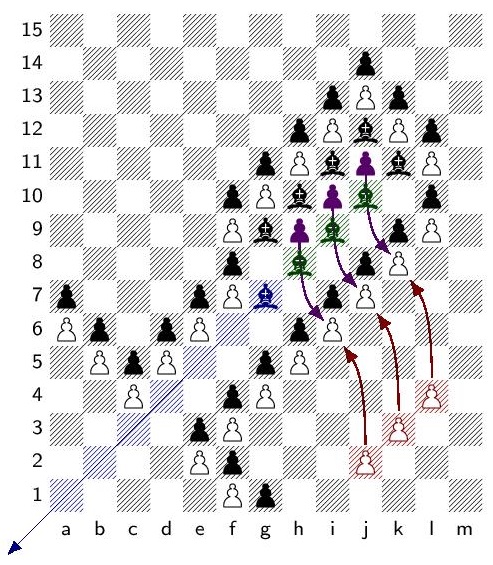
Abstract. I will give an introduction to the theory of infinite games, with examples drawn from infinite chess in order to illustrate various concepts, such as the transfinite game value of a position.

Infinite-Chess-TMWYF-2020 Slides.pdfDownload

See more of my posts on infinite chess.

Share:

  • Share on X (Opens in new window) X
  • Share on Facebook (Opens in new window) Facebook
  • Share on Reddit (Opens in new window) Reddit
  • Share on WhatsApp (Opens in new window) WhatsApp
  • Email a link to a friend (Opens in new window) Email
  • Print (Opens in new window) Print
  • More
  • Share on LinkedIn (Opens in new window) LinkedIn
  • Share on Tumblr (Opens in new window) Tumblr
  • Share on Pinterest (Opens in new window) Pinterest
Posted in Talks, Videos | Tagged game values, games, infinite chess, infinite games, TMWYF | 2 Replies

Infinitely More

Proof and the Art of Mathematics, MIT Press, 2020

Buy Me a Coffee

Recent Comments

  • WeightConvert on Infinite Sudoku and the Sudoku game
  • BodaciousTattvas on Set-theoretic mereology as a foundation of mathematics? Shandong University, Workshop on Mereology, China, June 2026
  • Joel David Hamkins on Set-theoretic mereology as a foundation of mathematics? Shandong University, Workshop on Mereology, China, June 2026
  • BodaciousTattvas on Set-theoretic mereology as a foundation of mathematics? Shandong University, Workshop on Mereology, China, June 2026
  • William on Set-theoretic mereology as a foundation of mathematics? Shandong University, Workshop on Mereology, China, June 2026

JDH on Twitter

My Tweets

RSS Mathoverflow activity

  • Answer by Joel David Hamkins for Was a computational hardness argument ever used to solve a mathematical conjecture?
    One of the standard elementary proofs of Gödel's incompleteness theorem follows the template you suggest. Namely, consider the theory of Peano arithmetic (PA). This theory is quite remarkable in that one can develop essentially all the classical elementary theory of numbers from these basic principles, and before the incompleteness theorem was known, it must have […]
  • Comment by Joel David Hamkins on Examples of eventual counterexamples
    @Number It's no problem---please don't worry about it. In general, you should feel free to edit posts on MathOverflow, since this is how the system is designed, and it works well. Edits are more likely to be accepted, however, when they are about matters of objective factual accuracy or notational corrections.
  • Comment by Joel David Hamkins on Examples of eventual counterexamples
    @AlekseiKulikov Indeed, since I also did not care for the edit, I have rolled it back to my answer. In my view the essence of the answer here does not require Kolmogorov complexity considerations, since for the phenomenon in question one doesn't need the description to be optimal. Nevertheless, the issue is similar to what […]
  • Comment by Joel David Hamkins on Was a computational hardness argument ever used to solve a mathematical conjecture?
    The argument template strikes me as having an affinity with the kind of argument where you prove existence of a phenomenon, such as a graph of a certain kind, by proving that it has nonzero probability in a suitable probability space.
  • Comment by Joel David Hamkins on Was a computational hardness argument ever used to solve a mathematical conjecture?
    Trivial problems are NP hard if and only if P=NP.
  • Comment by Joel David Hamkins on A question relating to the measurability of cardinals
    Yes, that is the phenomenon of the first type of counterexample. The second type is a different phenomenon.
  • Answer by Joel David Hamkins for A question relating to the measurability of cardinals
    The principle is wrong and there are two main kinds of counterexamples. First, there are large cardinal notions that imply the existence of certain smaller large cardinals, including measurable cardinals, which do not themselves exhibit the property. For example: If there is a Woodin cardinal, then there are many measurable cardinals, but not every Woodin […]
  • Comment by Joel David Hamkins on A question relating to the measurability of cardinals
    Another kind of counterexample would be to take $A$ and $B$ as both very weak notions, but $\lambda$ happens to be measurable and $\kappa$ not measurable. For example, let $A(x)$ be "$x$ is Mahlo" and $B(x)$ is "$x$ is inaccessible. Now let $\kappa$ be the first Mahlo cardinal and let $\lambda$ be a measurable cardinal.

Meta

  • Log in
  • Entries feed
  • Comments feed
  • WordPress.org

Subscribe to receive update notifications by email.

Tags

  • absoluteness
  • bi-interpretation
  • buttons+switches
  • CH
  • chess
  • computability
  • continuum hypothesis
  • countable models
  • definability
  • determinacy
  • elementary embeddings
  • forcing
  • forcing axioms
  • games
  • GBC
  • generic multiverse
  • geology
  • HOD
  • indestructibility
  • infinitary computability
  • infinite chess
  • infinite games
  • ITTMs
  • kids
  • KM
  • large cardinals
  • Leibnizian models
  • maximality principle
  • modal logic
  • models of PA
  • multiverse
  • Notre Dame
  • open games
  • Oxford
  • philosophy of mathematics
  • pluralism
  • pointwise definable
  • potentialism
  • PSC-CUNY
  • supercompact
  • truth
  • universal algorithm
  • universal definition
  • universal program
  • Victoria Gitman
Proudly powered by WordPress