Skip to primary content
Skip to secondary content

Joel David Hamkins

mathematics and philosophy of the infinite

Joel David Hamkins

Main menu

  • Home
    • About
    • My Curriculum Vita
    • Contact
    • Comment Board
  • Publications
    • Publication list
    • Recent publications
    • Publications by topic
      • Automorphism towers
      • Infinitary computability
      • Infinitary utilitarianism
      • Large cardinals
    • My Research Collaborators
  • Talks
    • Talks
    • Recent and Upcoming Talks
    • Videos
  • Appointments and Grants
    • About Me
    • My Academic Appointments
    • Grants and Awards
  • Teaching
    • About My Courses
  • Students
    • About My Graduate Students
    • List of My Graduate Students
  • Mathematical Shorts
  • Math for Kids

Tag Archives: Cody Roux

The Church of Logic podcast, April 2025

Posted on April 21, 2025 by Joel David Hamkins
Reply

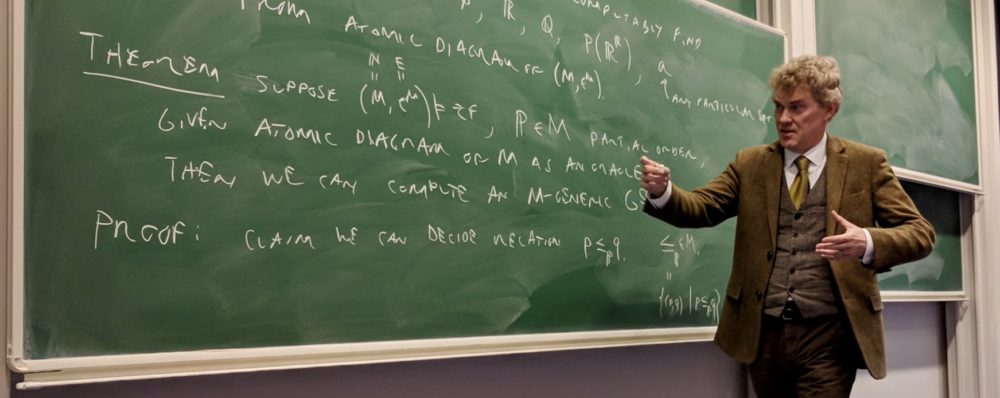
I was interviewed by Cody Roux for The Church of Logic podcast—a fascinating sweeping conversation on issues in the philosophy of mathematics and set theory, including what I described as a fundamental dichotomy between two perspectives on the nature of mathematics and what it is all about. Cody and I have affinities with opposite sides of this dichotomy, which made for a fruitful exchange.

Share:

  • Click to share on X (Opens in new window) X
  • Click to share on Facebook (Opens in new window) Facebook
  • Click to share on Reddit (Opens in new window) Reddit
  • Click to share on WhatsApp (Opens in new window) WhatsApp
  • Click to email a link to a friend (Opens in new window) Email
  • Click to print (Opens in new window) Print
  • More
  • Click to share on LinkedIn (Opens in new window) LinkedIn
  • Click to share on Tumblr (Opens in new window) Tumblr
  • Click to share on Pocket (Opens in new window) Pocket
  • Click to share on Pinterest (Opens in new window) Pinterest
Posted in Talks, Videos | Tagged Cody Roux, philosophy of logic, philosophy of mathematics, philosophy of set theory, podcast, The Church of Logic | Leave a reply

Infinitely More

Proof and the Art of Mathematics, MIT Press, 2020

Buy Me a Coffee

Recent Comments

  • Jerry on Draw an infinite chessboard in perspective, using straightedge only
  • Joel David Hamkins on Draw an infinite chessboard in perspective, using straightedge only
  • Jerry on Draw an infinite chessboard in perspective, using straightedge only
  • Joel David Hamkins on Did Turing ever halt? HPS Colloquium, Notre Dame, October 2025
  • Ad Antiquitatem on Did Turing ever halt? HPS Colloquium, Notre Dame, October 2025

JDH on Twitter

My Tweets

RSS Mathoverflow activity

  • Comment by Joel David Hamkins on Formal justification for Freiling's axiom of symmetry
    The title of your question doesn't seem to match the question(s) that you actually ask.
  • Comment by Joel David Hamkins on How to understand non-standard halting times?
    Just because PA is actually sound it doesn't follow that every model of PA thinks that PA is sound, and indeed, I have explained why some don't.
  • Comment by Joel David Hamkins on How to understand non-standard halting times?
    Well, in my example M thinks PA is inconsistent, so it thinks PA can prove anything. It doesn't agree that PA is sound, even though it happens to think every standard axiom of PA is true. It has problematic nonstandard axioms of PA.
  • Comment by Joel David Hamkins on How to understand non-standard halting times?
    Yes, that is totally right. The operation at finite stages is absolute.
  • Comment by Joel David Hamkins on How to understand non-standard halting times?
    Having a code of a proof that $p$ halts does not generally imply that one has a code of the halting computation. For example, in a model of PA+¬Con(PA), there will be codes of proofs that every single program halts, even though many of them do not, even in that model.
  • Answer by Joel David Hamkins for How to understand non-standard halting times?
    One of the key ideas underlying so much of our understanding of models of arithmetic, including the incompleteness theorems and so much more, is the arithmetization phenomenon. Arithmetization shows that essentially any finite combinatorial concept can be expressed using only the very basic language of arithmetic, with addition and multiplication only. One commonly takes the […]
  • Comment by Joel David Hamkins on Finding the largest integer describable with a string of symbols of predefined length
    @JackEdwardTisdell Yes, that is what I meant.
  • Comment by Joel David Hamkins on Does anyone still seriously doubt the consistency of $ZFC$?
    Well, I had said the conflation is present even in PA, which is of course much weaker than ACA. I don't see what "real-world" has to do with anything, since we have even less understanding of the physical world, which becomes more deeply mysterious the more we know about it, than of arithmetic. I am […]

Meta

  • Log in
  • Entries feed
  • Comments feed
  • WordPress.org

Subscribe to receive update notifications by email.

Tags

  • absoluteness
  • buttons+switches
  • CH
  • chess
  • computability
  • continuum hypothesis
  • countable models
  • definability
  • determinacy
  • elementary embeddings
  • forcing
  • forcing axioms
  • games
  • GBC
  • generic multiverse
  • geology
  • ground axiom
  • HOD
  • indestructibility
  • infinitary computability
  • infinite chess
  • infinite games
  • ITTMs
  • kids
  • KM
  • large cardinals
  • Leibnizian models
  • maximality principle
  • modal logic
  • models of PA
  • multiverse
  • Notre Dame
  • open games
  • Oxford
  • philosophy of mathematics
  • pluralism
  • pointwise definable
  • potentialism
  • PSC-CUNY
  • supercompact
  • truth
  • universal algorithm
  • universal definition
  • universal program
  • Victoria Gitman
Proudly powered by WordPress