Skip to primary content
Skip to secondary content

Joel David Hamkins

mathematics and philosophy of the infinite

Joel David Hamkins

Main menu

  • Home
    • About
    • My Curriculum Vita
    • Contact
    • Comment Board
  • Publications
    • Publication list
    • Recent publications
    • Publications by topic
      • Automorphism towers
      • Infinitary computability
      • Infinitary utilitarianism
      • Large cardinals
    • My Research Collaborators
  • Talks
    • Talks
    • Recent and Upcoming Talks
    • Videos
  • Appointments and Grants
    • About Me
    • My Academic Appointments
    • Grants and Awards
  • Teaching
    • About My Courses
  • Students
    • About My Graduate Students
    • List of My Graduate Students
  • Mathematical Shorts
  • Math for Kids

Tag Archives: Digital Gnosis

Frege’s philosophy of mathematics—Interview with Nathan Ormond, December 2021

Posted on October 10, 2021 by Joel David Hamkins
Reply

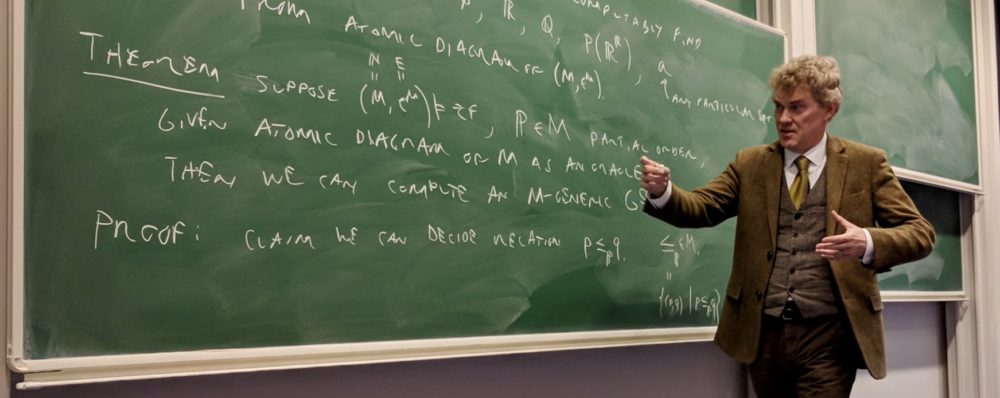
I was interviewed by Nathan Ormond for a discussion on Frege’s philosophy of mathematics for his YouTube channel, Digital Gnosis, on 10 December 2021 at 4pm.

The interview concludes with a public comment and question & answer session.
Share:

  • Click to share on X (Opens in new window) X
  • Click to share on Facebook (Opens in new window) Facebook
  • Click to share on Reddit (Opens in new window) Reddit
  • Click to share on WhatsApp (Opens in new window) WhatsApp
  • Click to email a link to a friend (Opens in new window) Email
  • Click to print (Opens in new window) Print
  • More
  • Click to share on LinkedIn (Opens in new window) LinkedIn
  • Click to share on Tumblr (Opens in new window) Tumblr
  • Click to share on Pocket (Opens in new window) Pocket
  • Click to share on Pinterest (Opens in new window) Pinterest
Posted in Events, Talks, Videos | Tagged Digital Gnosis, Frege, philosophy of mathematics | Leave a reply

Infinitely More

Proof and the Art of Mathematics, MIT Press, 2020

Buy Me a Coffee

Recent Comments

  • Joel David Hamkins on Cheryl’s Rational Gifts: transfinite epistemic logic puzzle challenge!
  • Connect Master on Cheryl’s Rational Gifts: transfinite epistemic logic puzzle challenge!
  • Jenga Views – Making Your Own Sense on Math for kids: fun with orthoprojections!
  • Joel David Hamkins on Largest-number contest: what is the largest number that you can describe on an index card?
  • Cayden Wood on Largest-number contest: what is the largest number that you can describe on an index card?

JDH on Twitter

My Tweets

RSS Mathoverflow activity

  • Comment by Joel David Hamkins on What good alternatives are there to "Barcan Formula"
    For example, this page is a little better: en.wikipedia.org/wiki/Redundancy_theory_of_truth, linked from your page. But in my view, Tarski should be much more prominent on that page, and also they don't even mention his definition of satisfaction $M\models\varphi$, which is the principle mathematizing instance of this theory.
  • Comment by Joel David Hamkins on What good alternatives are there to "Barcan Formula"
    That wikipedia page does not seem to be about the disquotational theory of truth, which is 100% about Tarski and his recursive definition of truth in a model. The sentence "snow is white" is true iff snow is white is the canonical example of this theory. It is the same idea behind the T-scheme, which […]
  • Comment by Joel David Hamkins on What good alternatives are there to "Barcan Formula"
    Sorry, I have no idea. This is the totally standard definition of satisfaction, which is given in every single logic textbook.
  • Comment by Joel David Hamkins on What good alternatives are there to "Barcan Formula"
    Similarly, the quantifier case has that "for all $x,\ \varphi$" is true if and only if for all $x$, "$\varphi$" is true. And your schema is one direction of this biconditional.
  • Comment by Joel David Hamkins on What good alternatives are there to "Barcan Formula"
    The term "disquotational theory of truth" is commonly used to describe the nature of Tarski's definition of the satisfaction relation $M\models\varphi$, since one defines that $\varphi\wedge\psi$ is true iff $\varphi$ is true and $\psi$ is true. One thus turns syntax into semantics, just as in the famous example: "Snow is white" is true if and […]
  • Comment by Joel David Hamkins on Is it inconsistent for all rigid continuum sized structures to be second-order Leibnizian?
    Related question: mathoverflow.net/a/206058/1946
  • Comment by Joel David Hamkins on What good alternatives are there to "Barcan Formula"
    This is one direction of Tarski's disquotational requirement in the compositional theory of truth. In the first case, however, you are in effect putting the quotations back on, so: "quotational"?
  • Comment by Joel David Hamkins on Indecomposable binary relations
    @DominicvanderZypen I don't find "indecomposable" to be the right word, since for it to fail means that $R$ doesn't shrink inside $A$ or it's complement. But that doesn't strike me as a form of decomposition.

Meta

  • Log in
  • Entries feed
  • Comments feed
  • WordPress.org

Subscribe to receive update notifications by email.

Tags

  • absoluteness
  • bi-interpretation
  • buttons+switches
  • CH
  • chess
  • computability
  • continuum hypothesis
  • countable models
  • definability
  • determinacy
  • elementary embeddings
  • forcing
  • forcing axioms
  • games
  • GBC
  • generic multiverse
  • geology
  • HOD
  • indestructibility
  • infinitary computability
  • infinite chess
  • infinite games
  • ITTMs
  • kids
  • KM
  • large cardinals
  • Leibnizian models
  • maximality principle
  • modal logic
  • models of PA
  • multiverse
  • Notre Dame
  • open games
  • Oxford
  • philosophy of mathematics
  • pluralism
  • pointwise definable
  • potentialism
  • PSC-CUNY
  • supercompact
  • truth
  • universal algorithm
  • universal definition
  • universal program
  • Victoria Gitman
Proudly powered by WordPress