Mathematicians do not agree on the essential structure of the complex numbers, ASL/APA Central Division Meeting, Chicago, February 2026

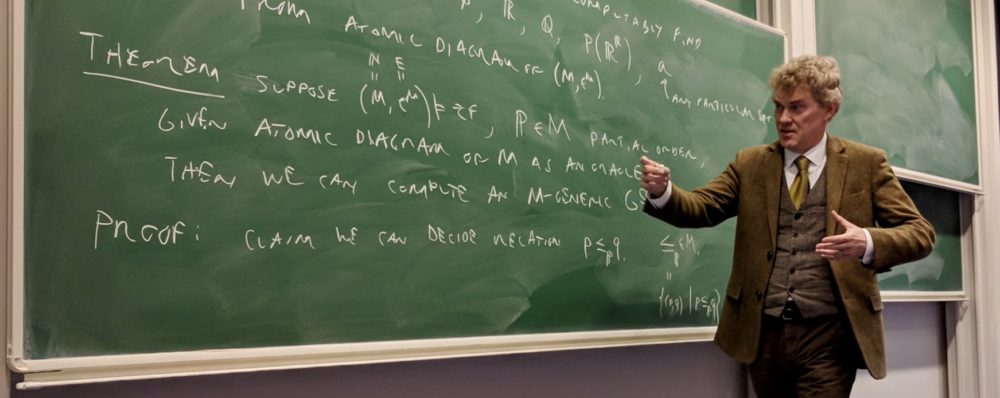
I have been asked by the ASL to fill in as a last-minute substitute speaker for the ASL session at the upcoming 2026 APA Central Division Meeting in Chicago, February 18-21, 2026, due to a late cancellation of one of the plenary speakers, James Walsh, who regrettably is unable to speak. My talk will be part of the Wednesday evening ASL session 6-7:50.

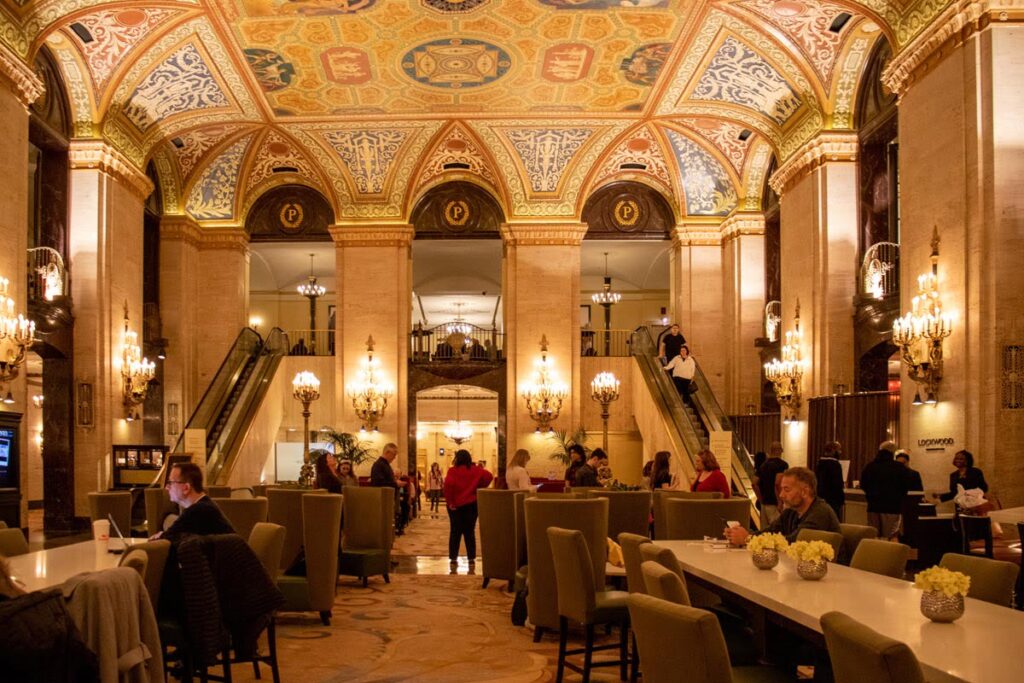
Please join me in Chicago at the elegant Palmer House hotel—we have a great lineup of talks.
Title: Mathematicians do not agree on the essential structure of the complex numbers

Abstract: What is the essential structure of the complex numbers? Mathematicians, it turns out, do not generally agree—indeed one can find sharply worded disagreements. Do we have a purely algebraic conception of the complex numbers, taking it as an algebraically closed field with only its algebraic structure? Or do we have an analytic view, as a field over the real numbers, distinguished as a particular subfield? Or should we have a topological view? Perhaps we have a rigid conception of the complex plane, with the coordinate structure of real and imaginary parts. Many mathematicians find it fundamentally wrong to break the symmetry between i and -i, and indeed the various perspectives give rise to fundamentally different understandings of the automorphism group, and they are not all fully bi-interpretable nor even mutually interpretable. I shall place the whole discussion into the context of the philosophy of structuralism and the question of what is a number.

This talk is based on my essay of the same title:

Pluralism in the foundations of mathematics, ASL invited address, joint APA/ASL meeting, New York, January 2024

This will be an invited ASL address at the joint meeting of the ASL with the APA Eastern Division conference, held in New York 15-18 January 2024. My talk will be 16 January 2024 11:00 am.

Note the plurality of Empire State Buildings...

Abstract. I shall give an account of the debate on set-theoretic pluralism and pluralism generally in the foundations of mathematics, including arithmetic. Is there ultimately just
one mathematical universe, the final background context, in which every mathematical
question has an absolute, determinate answer? Or do we have rather a multiverse of
mathematical foundations? Some mathematicians and philosophers favor a hybrid notion, with pluralism at the higher realms of set theory, but absoluteness for arithmetic.
What grounds are there for these various positions? How are we to adjudicate between
them? What ultimately is the purpose of a foundation of mathematics?

See the related paper on the mathematical thought experiment: How the continuum hypothesis could have been a fundamental axiom.

Embeddability amongst the countable models of set theory, plenary talk for ASL / Joint Math Meetings in Baltimore, January 2014

A one-hour plenary talk for the ASL at the Joint Math Meetings, January 15-18, 2014 in Baltimore, MD.

Saturday January 18, 2014, 2:00 p.m.-2:50 p.m, Room 319 BCC

Abstract. A surprisingly vigorous embeddability phenomenon has recently been uncovered amongst the countable models of set theory.  In particular, embeddability is linear:  for any two countable models of set theory, one of them is isomorphic to a submodel of the other.  In particular, every countable model of set theory, including every well-founded model, is isomorphic to a submodel of its own constructible universe, so that there is an embedding $j:M\to L^M$ for which $x\in y\iff j(x)\in j(y)$. The proof uses universal digraph combinatorics, including an acyclic version of the countable random digraph, which I call the countable random $\mathbb{Q}$-graded digraph, and higher analogues arising as uncountable Fraïssé limits, leading to the hypnagogic digraph, a set-homogeneous, class-universal, surreal-numbers-graded acyclic class digraph, closely connected with the surreal numbers.

Slides | ArticleJMM Schedule