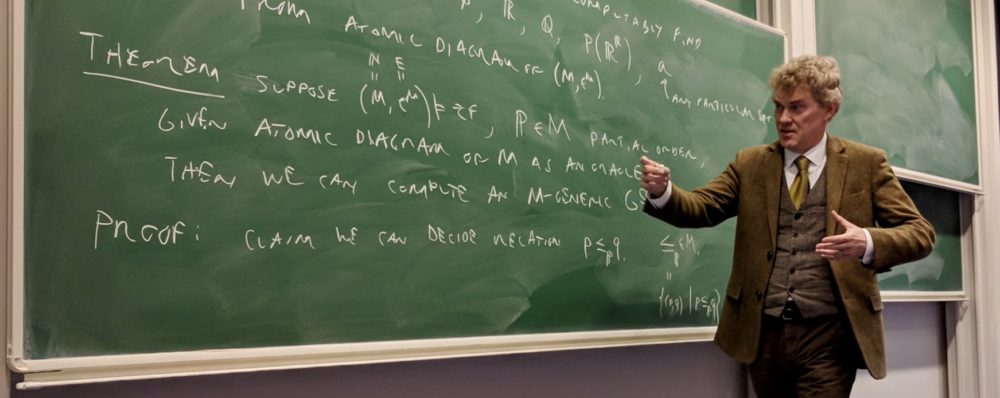
What is the theory ZFC without power set?

[bibtex key=”GitmanHamkinsJohnstone2016:WhatIsTheTheoryZFC-Powerset?”]

This is joint work with Victoria Gitman and Thomas Johnstone.

We show that the theory ZFC-, consisting of the usual axioms of ZFC but with the power set axiom removed-specifically axiomatized by extensionality, foundation, pairing, union, infinity, separation, replacement and the assertion that every set can be well-ordered-is weaker than commonly supposed and is inadequate to establish several basic facts often desired in its context. For example, there are models of ZFC- in which $\omega_1$ is singular, in which every set of reals is countable, yet $\omega_1$ exists, in which there are sets of reals of every size $\aleph_n$, but none of size $\aleph_\omega$, and therefore, in which the collection axiom sceme fails; there are models of ZFC- for which the Los theorem fails, even when the ultrapower is well-founded and the measure exists inside the model; there are models of ZFC- for which the Gaifman theorem fails, in that there is an embedding $j:M\to N$ of ZFC- models that is $\Sigma_1$-elementary and cofinal, but not elementary; there are elementary embeddings $j:M\to N$ of ZFC- models whose cofinal restriction $j:M\to \bigcup j“M$ is not elementary. Moreover, the collection of formulas that are provably equivalent in ZFC- to a $\Sigma_1$-formula or a $\Pi_1$-formula is not closed under bounded quantification. Nevertheless, these deficits of ZFC- are completely repaired by strengthening it to the theory $\text{ZFC}^-$, obtained by using collection rather than replacement in the axiomatization above. These results extend prior work of Zarach.

See Victoria Gitman’s summary post on the article

The Logic Bike

In 2004 I was a Mercator Gastprofessor at Universität MünHoratio on the Logic Bikester, Institut für mathematische Logik  und Grundlagenforschung, where I was involved with interesting mathematics, particularly with Ralf Schindler and Gunter Fuchs, who is now at CUNY.

At that time, I had bought a bicycle, and celebrated Münster’s incredible bicycle culture, a city where the number of registered bicycles significantly exceeds the number of inhabitants.  I have long thought that Münster gets something fundamentally right about how to live in a city with bicycles, and the rest of the world should take note.  I am pleased to say that in recent years, New York City is becoming far more bicycle-friendly, although we don’t hold a candle to Münster.

At the end of my position, I donated the bicycle to the Logic Institute, where it has now become known as the Logic Bike, and where I have recently learned that over the years it has now been ridden by a large number of prominent set theorists; it must be one of the few bicycles in the world to have its own web page!

Set theory: universe or multiverse? Vienna, 2011

This talk was held as part of the Logic Cafe series at the Institute of Philosophy at the University of Vienna, October 31, 2011.

A traditional Platonist view in set theory, what I call the universe view, holds that there is an absolute background concept of set and a corresponding absolute background set-theoretic universe in which every set-theoretic assertion has a final, definitive truth value. On the multiverse view, in constrast, there are many distinct concepts of set, each instantiated in a corresponding set-theoretic universe, and a corresponding pluralism of set-theoretic truths. In this talk, after framing the debate, I shall argue that the multiverse position explains our experience with the enormous diversity of set-theoretic possibilities, a phenomenon that challenges the universe view. In particular, I shall argue that the continuum hypothesis is settled on the multiverse view by our extensive knowledge about how it behaves in the multiverse, and as a result it can no longer be settled in the manner formerly hoped for.

Slides | Article | Logic Cafe, Uni. Wien

Must there be non-definable numbers? Pointwise definability and the math-tea argument, KGRC, Vienna 2011

This talk will be a part of the “Advanced Introduction” series for graduate students at the the Kurt Gödel Research Center, November 4, 2011.

An old argument, heard perhaps at math tea, proceeds: “there must be some real numbers that we can neither describe nor define, since there are uncountably many reals, but only countably many definitions.” Does it withstand scrutiny? In this talk, I will discuss the phenomenon of pointwise definable models of set theory, in which every object is definable without parameters. In addition to classical and folklore results on the existence of pointwise definable models of set theory, the main new theorem is that every countable model of ZFC and indeed of GBC has an extension to a model of set theory with the same ordinals, in which every set and class is definable without parameters. This is joint work with Jonas Reitz and David Linetsky, and builds on work of S. Simpson, R. Kossak, J. Schmerl, S. Friedman and A. Enayat.

Slides | Article

Generalizations of the Kunen inconsistency, KGRC, Vienna 2011

This is a talk at the research seminar of the Kurt Gödel Research Center, November 3, 2011.

I shall present several generalizations of the well-known Kunen inconsistency that there is no nontrivial elementary embedding from the set-theoretic universe V to itself, including generalizations-of-generalizations previously established by Woodin and others.  For example, there is no nontrivial elementary embedding from the universe V to a set-forcing extension V[G], or conversely from V[G] to V, or more generally from one ground model of the universe to another, or between any two models that are eventually stationary correct, or from V to HOD, or conversely from HOD to V, or from V to the gHOD, or conversely from gHOD to V; indeed, there can be no nontrivial elementary embedding from any definable class to V.  Other results concern generic embeddings, definable embeddings and results not requiring the axiom of choice.  I will aim for a unified presentation that weaves together previously known unpublished or folklore results along with some new contributions.  This is joint work with Greg Kirmayer and Norman Perlmutter.

Slides | Article

The hierarchy of equivalence relations on the natural numbers under computable reducibility

[bibtex key=CoskeyHamkinsMiller2012:HierarchyOfEquivalenceRelationsOnN]

We define and elaborate upon the notion of computable reducibility between equivalence relations on the natural numbers, providing a natural computable analogue of Borel reducibility, and investigate the hierarchy to which it gives rise. The theory appears well suited for an analysis of equivalence relations on classes of c.e. structures, a rich context with many natural examples, such as the isomorphism relation on c.e. graphs or on computably presented groups. In this regard, our exposition extends earlier work in the literature concerning the classification of computable structures. An abundance of open questions remain.

See Sam’s post on this article

Set-theoretic geology

[bibtex key=FuchsHamkinsReitz2015:Set-theoreticGeology]

A ground of the universe V is a transitive proper class W subset V, such that W is a model of ZFC and V is obtained by set forcing over W, so that V = W[G] for some W-generic filter G subset P in W . The model V satisfies the ground axiom GA if there are no such W properly contained in V . The model W is a bedrock of V if W is a ground of V and satisfies the ground axiom. The mantle of V is the intersection of all grounds of V . The generic mantle of V is the intersection of all grounds of all set-forcing extensions of V . The generic HOD, written gHOD, is the intersection of all HODs of all set-forcing extensions. The generic HOD is always a model of ZFC, and the generic mantle is always a model of ZF. Every model of ZFC is the mantle and generic mantle of another model of ZFC. We prove this theorem while also controlling the HOD of the final model, as well as the generic HOD. Iteratively taking the mantle penetrates down through the inner mantles to what we call the outer core, what remains when all outer layers of forcing have been stripped away. Many fundamental questions remain open.

The rigid relation principle, a new weak choice principle

[bibtex key=HamkinsPalumbo2012:TheRigidRelationPrincipleANewWeakACPrinciple]

The rigid relation principle, introduced in this article, asserts that every set admits a rigid binary relation. This follows from the axiom of choice, because well-orders are rigid, but we prove that it is neither equivalent to the axiom of choice nor provable in Zermelo-Fraenkel set theory without the axiom of choice. Thus, it is a new weak choice principle. Nevertheless, the restriction of the principle to sets of reals (among other general instances) is provable without the axiom of choice.

This paper arose out of my related mathoverflow question:  Does every set admit a rigid binary relation (and how is this related to the axiom of choice)?

Generalizations of the Kunen inconsistency

[bibtex key=HamkinsKirmayerPerlmutter2012:GeneralizationsOfKunenInconsistency]

We present several generalizations of the well-known Kunen inconsistency that there is no nontrivial elementary embedding from the set-theoretic universe V to itself. For example, there is no elementary embedding from the universe V to a set-forcing extension V[G], or conversely from V[G] to V, or more generally from one ground model of the universe to another, or between any two models that are eventually stationary correct, or from V to HOD, or conversely from HOD to V, or indeed from any definable class to V, among many other possibilities we consider, including generic embeddings, definable embeddings and results not requiring the axiom of choice. We have aimed in this article for a unified presentation that weaves together some previously known unpublished or folklore results, several due to Woodin and others, along with our new contributions.

Pointwise definable models of set theory

[bibtex key=HamkinsLinetskyReitz2013:PointwiseDefinableModelsOfSetTheory]

One occasionally hears the argument—let us call it the math-tea argument, for perhaps it is heard at a good math tea—that there must be real numbers that we cannot describe or define, because there are are only countably many definitions, but uncountably many reals.  Does it withstand scrutiny?

This article provides an answer.  The article has a dual nature, with the first part aimed at a more general audience, and the second part providing a proof of the main theorem:  every countable model of set theory has an extension in which every set and class is definable without parameters.  The existence of these models therefore exhibit the difficulties in formalizing the math tea argument, and show that robust violations of the math tea argument can occur in virtually any set-theoretic context.

A pointwise definable model is one in which every object is definable without parameters. In a model of set theory, this property strengthens V=HOD, but is not first-order expressible. Nevertheless, if ZFC is consistent, then there are continuum many pointwise definable models of ZFC. If there is a transitive model of ZFC, then there are continuum many pointwise definable transitive models of ZFC. What is more, every countable model of ZFC has a class forcing extension that is pointwise definable. Indeed, for the main contribution of this article, every countable model of Godel-Bernays set theory has a pointwise definable extension, in which every set and class is first-order definable without parameters.

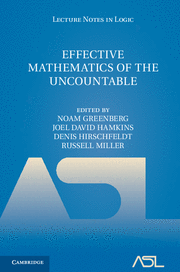
Effective Mathemematics of the Uncountable

EMU book jacket[bibtex key=EMU]

Classical computable model theory is most naturally concerned with countable domains. There are, however, several methods – some old, some new – that have extended its basic concepts to uncountable structures. Unlike in the classical case, however, no single dominant approach has emerged, and different methods reveal different aspects of the computable content of uncountable mathematics. This book contains introductions to eight major approaches to computable uncountable mathematics: descriptive set theory; infinite time Turing machines; Blum-Shub-Smale computability; Sigma-definability; computability theory on admissible ordinals; E-recursion theory; local computability; and uncountable reverse mathematics. This book provides an authoritative and multifaceted introduction to this exciting new area of research that is still in its early stages. It is ideal as both an introductory text for graduate and advanced undergraduate students, and a source of interesting new approaches for researchers in computability theory and related areas.

Many of the authors whose work appears in this volume were also involved in the Effective Mathematics of the Uncountable conferences EMU 2008 and EMU 2009, held at the CUNY Graduate Center.

Infinite time Turing machines and an application to the hierarchy of equivalence relations on the reals

[bibtex key=CoskeyHamkins2013:ITTMandApplicationsToEquivRelations]

We describe the basic theory of infinite time Turing machines and some recent developments, including the infinite time degree theory, infinite time complexity theory, and infinite time computable model theory. We focus particularly on the application of infinite time Turing machines to the analysis of the hierarchy of equivalence relations on the reals, in analogy with the theory arising from Borel reducibility. We define a notion of infinite time reducibility, which lifts much of the Borel theory into the class ${\Delta}^1_2$ in a satisfying way.

The set-theoretical multiverse

[bibtex key=Hamkins2012:TheSet-TheoreticalMultiverse]

The multiverse view in set theory, introduced and argued for in this article, is the view that there are many distinct concepts of set, each instantiated in a corresponding set-theoretic universe. The universe view, in contrast, asserts that there is an absolute background set concept, with a corresponding absolute set-theoretic universe in which every set-theoretic question has a definite answer. The multiverse position, I argue, explains our experience with the enormous diversity of set-theoretic possibilities, a phenomenon that challenges the universe view. In particular, I argue that the continuum hypothesis is settled on the multiverse view by our extensive knowledge about how it behaves in the multiverse, and as a result it can no longer be settled in the manner formerly hoped for.

Multiversive at n-Category Cafe | Multiverse on Mathoverflow

Infinite time decidable equivalence relation theory

[bibtex key=CoskeyHamkins2011:InfiniteTimeComputableEquivalenceRelations]

We introduce an analog of the theory of Borel equivalence relations in which we study equivalence relations that are decidable by an infinite time Turing machine. The Borel reductions are replaced by the more general class of infinite time computable functions. Many basic aspects of the classical theory remain intact, with the added bonus that it becomes sensible to study some special equivalence relations whose complexity is beyond Borel or even analytic. We also introduce an infinite time generalization of the countable Borel equivalence relations, a key subclass of the Borel equivalence relations, and again show that several key properties carry over to the larger class. Lastly, we collect together several results from the literature regarding Borel reducibility which apply also to absolutely $\Delta^1_2$ reductions, and hence to the infinite time computable reductions.

The set-theoretical multiverse: a natural context for set theory, Japan 2009

Joel David Hamkins, “The Set-theoretic Multiverse : A Natural Context for Set Theory”, Annals of the Japan Association for Philosophy of Science, ISSN 0453-0691, the Japan Association for Philosophy of Science, 2011, vol 19, 37055. DOI:10.4288/jafpos.19.0_37

This article is based on a talk I gave at the conference in honor of the retirement of Yuzuru Kakuda in Kobe, Japan, March 7, 2009. I would like to express my gratitude to Kakuda-sensei and the rest of the logic group in Kobe for the opportunities provided to me to participate in logic in Japan. In particular, my time as a JSPS Fellow in the logic group at Kobe University in 1998 was a formative experience. I was part of a vibrant research group in Kobe; I enjoyed Japanese life, learned to speak a little Japanese and made many friends. Mathematically, it was a productive time, and after years away how pleasant it is for me to see that ideas planted at that time, small seedlings then, have grown into tall slender trees.

Set theorists often take their subject as constituting a foundation for the rest of mathematics, in the sense that other abstract mathematical objects can be construed fundamentally as sets. In this way, they regard the set-theoretic universe as the universe of all mathematics. And although many set-theorists affirm the Platonic view that there is just one universe of all sets, nevertheless the most powerful set-theoretic tools developed over the past half century are actually methods of constructing alternative universes. With forcing and other methods, we can now produce diverse models of ZFC set theory having precise, exacting features. The fundamental object of study in set theory has thus become the model of set theory, and the subject consequently begins to exhibit a category-theoretic second-order nature. We have a multiverse of set-theoretic worlds, connected by forcing and large cardinal embeddings like constellations in a dark sky. In this article, I will discuss a few emerging developments illustrating this second-order nature. The work engages pleasantly with various philosophical views on the nature of mathematical existence.