Structural connections between a forcing class and its modal logic

[bibtex key=HamkinsLeibmanLoewe2015:StructuralConnectionsForcingClassAndItsModalLogic]

The modal logic of forcing arises when one considers a model of set theory in the context of all its forcing extensions, interpreting $\square$ as “in all forcing extensions” and $\Diamond$ as “in some forcing extension”. In this modal language one may easily express sweeping general forcing principles, such as $\Diamond\square\varphi\to\square\Diamond\varphi$, the assertion that every possibly necessary statement is necessarily possible, which is valid for forcing, or $\Diamond\square\varphi\to\varphi$, the assertion that every possibly necessary statement is true, which is the maximality principle, a forcing axiom independent of but equiconsistent with ZFC (see A simple maximality principle).

Every definable forcing class similarly gives rise to the corresponding forcing modalities, for which one considers extensions only by forcing notions in that class. In previous work, we proved that if ZFC is consistent, then the ZFC-provably valid principles of the class of all forcing are precisely the assertions of the modal theory S4.2 (see The modal logic of forcing). In this article, we prove that the provably valid principles of collapse forcing, Cohen forcing and other classes are in each case exactly S4.3; the provably valid principles of c.c.c. forcing, proper forcing, and others are each contained within S4.3 and do not contain S4.2; the provably valid principles of countably closed forcing, CH-preserving forcing and others are each exactly S4.2; and the provably valid principles of $\omega_1$-preserving forcing are contained within S4.tBA. All these results arise from general structural connections we have identified between a forcing class and the modal logic of forcing to which it gives rise, including the connection between various control statements, such as buttons, switches and ratchets, and their corresponding forcing validities. These structural connections therefore support a forcing-only analysis of other diverse forcing classes.

Preprints available at:  ar$\chi$iv | NI12055-SAS | UvA ILLC PP-2012-19 | HBM 446

Must there be numbers we cannot describe or define? Pointwise definability and the Math Tea argument, Bristol, April 2012

This is a talk I plan to give to the set theory seminar at the University of Bristol on April 18, 2012.

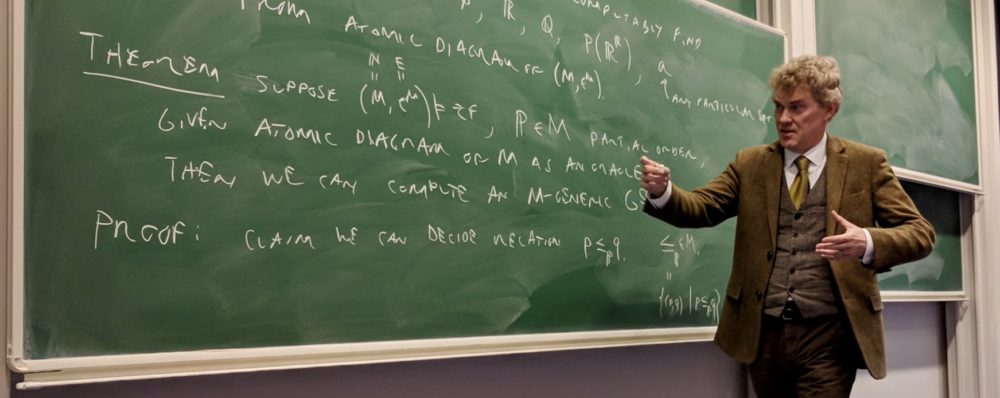
An old argument, heard at a good math tea, proceeds: “there must be some real numbers that we can neither describe nor define, since there are uncountably many reals, but only countably many definitions.” Does it withstand scrutiny? In this talk, I will discuss the phenomenon of pointwise definable models of set theory, in which every object is definable without parameters. In addition to classical and folklore results on the existence of pointwise definable models of set theory, the main new theorem is that every countable model of ZFC and indeed of GBC has an extension to a model of set theory with the same ordinals, in which every set and class is definable without parameters. This is joint work with Jonas Reitz and David Linetsky, and builds on work of S. Simpson, R. Kossak, J. Schmerl, S. Friedman and A. Enayat.

slides | article

The automorphism tower problem for groups, Bristol 2012

Isaac Newton 20th Anniversary Lecture.  This is a talk I shall give at the University of Bristol, School of Mathematics, April 17, 2012, at the invitation of Philip Welch.

The automorphism tower of a group is obtained by computing its automorphism group, the automorphism group of that group, and so on, iterating transfinitely. The question, known as the automorphism tower problem, is whether the tower ever terminates, whether there is eventually a fixed point, a group that is isomorphic to its automorphism group by the natural map. Wielandt (1939) proved the classical result that the automorphism tower of any finite centerless group terminates in finitely many steps. This was successively generalized to larger and larger collections of groups until Thomas (1985) proved that every centerless group has a terminating automorphism tower.  Building on this, I proved (1997) that every group has a terminating automorphism tower.  After giving an account of this theorem, I will give an overview of my work with Simon Thomas, as well as newer work with Gunter Fuchs and work of Philipp Lücke, which reveal a set-theoretic essence for the automorphism tower of a group: the very same group can have wildly different towers in different models of set theory.

slides | list of my articles on automorphism towers | abstract at Bristol

Is the dream solution of the continuum hypothesis attainable?

[bibtex key=Hamkins2015:IsTheDreamSolutionToTheContinuumHypothesisAttainable]

Many set theorists yearn for a definitive solution of the continuum problem, what I call a  dream solution, one by which we settle the continuum hypothesis (CH) on the basis of a new fundamental principle of set theory, a missing axiom, widely regarded as true, which determines the truth value of CH.  In an earlier article, I have described the dream solution template as proceeding in two steps: first, one introduces the new set-theoretic principle, considered obviously true for sets in the same way that many mathematicians find the axiom of choice or the axiom of replacement to be true; and second, one proves the CH or its negation from this new axiom and the other axioms of set theory. Such a situation would resemble Zermelo’s proof of the ponderous well-order principle on the basis of the comparatively natural axiom of choice and the other Zermelo axioms. If achieved, a dream solution to the continuum problem would be remarkable, a cause for celebration.

In this article, however, I argue that a dream solution of CH has become impossible to achieve. Specifically, what I claim is that our extensive experience in the set-theoretic worlds in which CH is true and others in which CH is false prevents us from looking upon any statement settling CH as being obviously true. We simply have had too much experience by now with the contrary situation. Even if set theorists initially find a proposed new principle to be a natural, obvious truth, nevertheless once it is learned that the principle settles CH, then this preliminary judgement will evaporate in the face of deep experience with the contrary, and set-theorists will look upon the statement merely as an intriguing generalization or curious formulation of CH or $\neg$CH, rather than as a new fundamental truth. In short, success in the second step of the dream solution will inevitably undermine success in the first step.

This article is based upon an argument I gave during the course of a three-lecture tutorial on set-theoretic geology at the summer school Set Theory and Higher-Order Logic: Foundational Issues and Mathematical Development, at the University of London, Birkbeck in August 2011.  Much of the article is adapted from and expands upon the corresponding section of material in my article The set-theoretic multiverse.

Philosophy of set theory, Fall 2011, NYU PH GA 1180

I taught a course in Fall 2011 at NYU entitled Topics in Logic: set theory and the philosophy of set theory, aimed at graduate students in philosophy and others who want to gain greater understanding of some of the set-theoretic topics central to work in the philosophy of set theory.  The course began with a review of the mathematical ideas, including a presentation of large cardinals, strong axioms of infinity and their associated elementary embeddings of the universe, and forcing, emphasizing the connection with the Boolean ultrapower and Boolean-valued models, but discussing the alternative formalizations. The second part of the course covers some of the philosophical literature, including what it means to accept or believe mathematical axioms, whether mathematics needs new axioms, the criteria one might use when adopting new axioms, and the question of pluralism and categoricity in set theory.

Here is a partial list of our readings:

1. Mathematical background.

2.  Penelope Maddy, “Believing the axioms”, in two parts.  JSL vols. 52 and 53. Part 1Part 2

3. Chris Freiling, “Axioms of Symmetry: throwing darts at the real number line,”
JSL, vol. 51.   http://www.jstor.org/stable/2273955

4. W. N. Reinhardt, “Remarks on reflection principles, large cardinals, and elementary embeddings,” Proceedings of Symposia in Pure Mathematics, Vol 13, Part II, 1974, pp. 189-205.

5. Donald Martin, “Multiple universes of sets and indeterminate truth values,” Topoi 20, 5–16, 2001.

6. Hartry Field, “Which undecidable mathematical sentences have determinate truth values,” as reprinted in his book Truth and the Absence of Fact, Oxford University Press, 2001.

7. A brief selection from Marc Balaguer, Platonism and Anti-Platonism in Mathematics, Oxford University Press, 1998, describing the plenitudinous Platonism position.

8. Daniel Isaacson, “The reality of mathematics and the case of set theory,” 2007.

9. J. D. Hamkins, “The set-theoretic multiverse,” to appear in the Review of Symbolic Logic.

10.  Solomon Feferman, Does mathematics need new axioms? Text of an invited AMS-MAA joint meeting, San Diego, January, 1997.

11. Solomon Feferman, Is the continuum hypothesis a definite mathematical problem? Draft article for the Exploring the Frontiers of Independence lecture series at Harvard University, October, 2011.

12. Peter Koellner, Feferman On the Indefiniteness of CH, a commentary on Feferman’s EFI article.

13. Interpretability of theories, the interpretability degrees and Orey sentences in set theory and arithmetic.  Some of the basic material is found in Per Lindström’s book Aspects of Incompleteness, available at  http://projecteuclid.org/euclid.lnl/1235416274, particularly chapter 6, and some later chapters.

14. Haim Gaifman, “On ontology and realism in mathematics,” to appear in the Review of Symbolic Logic (special issue connected with the NYU philosophy of mathematics conference 2009).

15. Saharon Shelah, “Logical dreams,”  Bulletin of the AMS, 40(20):203–228, 2003. (Pre-publication version available at:http://arxiv.org/abs/math.LO/0211398)

16.  For mathematical/philosophical amusement, Philip Welch and Leon Horsten, “The aftermath.”

It’s been a great semester!

Inner models with large cardinal features usually obtained by forcing

[bibtex key=ApterGitmanHamkins2012:InnerModelsWithLargeCardinals]

We construct a variety of inner models exhibiting features usually obtained by forcing over universes with large cardinals. For example, if there is a supercompact cardinal, then there is an inner model with a Laver indestructible supercompact cardinal. If there is a supercompact cardinal, then there is an inner model with a supercompact cardinal $\kappa$ for which $2^\kappa=\kappa^+$, another for which $2^\kappa=\kappa^{++}$ and another in which the least strongly compact cardinal is supercompact. If there is a strongly compact cardinal, then there is an inner model with a strongly compact cardinal, for which the measurable cardinals are bounded below it and another inner model $W$ with a strongly compact cardinal $\kappa$, such that $H_{\kappa^+}^V\subseteq HOD^W$. Similar facts hold for supercompact, measurable and strongly Ramsey cardinals. If a cardinal is supercompact up to a weakly iterable cardinal, then there is an inner model of the Proper Forcing Axiom and another inner model with a supercompact cardinal in which GCH+V=HOD holds. Under the same hypothesis, there is an inner model with level by level equivalence between strong compactness and supercompactness, and indeed, another in which there is level by level inequivalence between strong compactness and supercompactness. If a cardinal is strongly compact up to a weakly iterable cardinal, then there is an inner model in which the least measurable cardinal is strongly compact. If there is a weakly iterable limit $\delta$ of ${\lt}\delta$-supercompact cardinals, then there is an inner model with a proper class of Laver-indestructible supercompact cardinals. We describe three general proof methods, which can be used to prove many similar results.

What is the theory ZFC without power set?

[bibtex key=”GitmanHamkinsJohnstone2016:WhatIsTheTheoryZFC-Powerset?”]

This is joint work with Victoria Gitman and Thomas Johnstone.

We show that the theory ZFC-, consisting of the usual axioms of ZFC but with the power set axiom removed-specifically axiomatized by extensionality, foundation, pairing, union, infinity, separation, replacement and the assertion that every set can be well-ordered-is weaker than commonly supposed and is inadequate to establish several basic facts often desired in its context. For example, there are models of ZFC- in which $\omega_1$ is singular, in which every set of reals is countable, yet $\omega_1$ exists, in which there are sets of reals of every size $\aleph_n$, but none of size $\aleph_\omega$, and therefore, in which the collection axiom sceme fails; there are models of ZFC- for which the Los theorem fails, even when the ultrapower is well-founded and the measure exists inside the model; there are models of ZFC- for which the Gaifman theorem fails, in that there is an embedding $j:M\to N$ of ZFC- models that is $\Sigma_1$-elementary and cofinal, but not elementary; there are elementary embeddings $j:M\to N$ of ZFC- models whose cofinal restriction $j:M\to \bigcup j“M$ is not elementary. Moreover, the collection of formulas that are provably equivalent in ZFC- to a $\Sigma_1$-formula or a $\Pi_1$-formula is not closed under bounded quantification. Nevertheless, these deficits of ZFC- are completely repaired by strengthening it to the theory $\text{ZFC}^-$, obtained by using collection rather than replacement in the axiomatization above. These results extend prior work of Zarach.

See Victoria Gitman’s summary post on the article

Set theory: universe or multiverse? Vienna, 2011

This talk was held as part of the Logic Cafe series at the Institute of Philosophy at the University of Vienna, October 31, 2011.

A traditional Platonist view in set theory, what I call the universe view, holds that there is an absolute background concept of set and a corresponding absolute background set-theoretic universe in which every set-theoretic assertion has a final, definitive truth value. On the multiverse view, in constrast, there are many distinct concepts of set, each instantiated in a corresponding set-theoretic universe, and a corresponding pluralism of set-theoretic truths. In this talk, after framing the debate, I shall argue that the multiverse position explains our experience with the enormous diversity of set-theoretic possibilities, a phenomenon that challenges the universe view. In particular, I shall argue that the continuum hypothesis is settled on the multiverse view by our extensive knowledge about how it behaves in the multiverse, and as a result it can no longer be settled in the manner formerly hoped for.

Slides | Article | Logic Cafe, Uni. Wien

Must there be non-definable numbers? Pointwise definability and the math-tea argument, KGRC, Vienna 2011

This talk will be a part of the “Advanced Introduction” series for graduate students at the the Kurt Gödel Research Center, November 4, 2011.

An old argument, heard perhaps at math tea, proceeds: “there must be some real numbers that we can neither describe nor define, since there are uncountably many reals, but only countably many definitions.” Does it withstand scrutiny? In this talk, I will discuss the phenomenon of pointwise definable models of set theory, in which every object is definable without parameters. In addition to classical and folklore results on the existence of pointwise definable models of set theory, the main new theorem is that every countable model of ZFC and indeed of GBC has an extension to a model of set theory with the same ordinals, in which every set and class is definable without parameters. This is joint work with Jonas Reitz and David Linetsky, and builds on work of S. Simpson, R. Kossak, J. Schmerl, S. Friedman and A. Enayat.

Slides | Article

Generalizations of the Kunen inconsistency, KGRC, Vienna 2011

This is a talk at the research seminar of the Kurt Gödel Research Center, November 3, 2011.

I shall present several generalizations of the well-known Kunen inconsistency that there is no nontrivial elementary embedding from the set-theoretic universe V to itself, including generalizations-of-generalizations previously established by Woodin and others.  For example, there is no nontrivial elementary embedding from the universe V to a set-forcing extension V[G], or conversely from V[G] to V, or more generally from one ground model of the universe to another, or between any two models that are eventually stationary correct, or from V to HOD, or conversely from HOD to V, or from V to the gHOD, or conversely from gHOD to V; indeed, there can be no nontrivial elementary embedding from any definable class to V.  Other results concern generic embeddings, definable embeddings and results not requiring the axiom of choice.  I will aim for a unified presentation that weaves together previously known unpublished or folklore results along with some new contributions.  This is joint work with Greg Kirmayer and Norman Perlmutter.

Slides | Article

Set-theoretic geology

[bibtex key=FuchsHamkinsReitz2015:Set-theoreticGeology]

A ground of the universe V is a transitive proper class W subset V, such that W is a model of ZFC and V is obtained by set forcing over W, so that V = W[G] for some W-generic filter G subset P in W . The model V satisfies the ground axiom GA if there are no such W properly contained in V . The model W is a bedrock of V if W is a ground of V and satisfies the ground axiom. The mantle of V is the intersection of all grounds of V . The generic mantle of V is the intersection of all grounds of all set-forcing extensions of V . The generic HOD, written gHOD, is the intersection of all HODs of all set-forcing extensions. The generic HOD is always a model of ZFC, and the generic mantle is always a model of ZF. Every model of ZFC is the mantle and generic mantle of another model of ZFC. We prove this theorem while also controlling the HOD of the final model, as well as the generic HOD. Iteratively taking the mantle penetrates down through the inner mantles to what we call the outer core, what remains when all outer layers of forcing have been stripped away. Many fundamental questions remain open.

The rigid relation principle, a new weak choice principle

[bibtex key=HamkinsPalumbo2012:TheRigidRelationPrincipleANewWeakACPrinciple]

The rigid relation principle, introduced in this article, asserts that every set admits a rigid binary relation. This follows from the axiom of choice, because well-orders are rigid, but we prove that it is neither equivalent to the axiom of choice nor provable in Zermelo-Fraenkel set theory without the axiom of choice. Thus, it is a new weak choice principle. Nevertheless, the restriction of the principle to sets of reals (among other general instances) is provable without the axiom of choice.

This paper arose out of my related mathoverflow question:  Does every set admit a rigid binary relation (and how is this related to the axiom of choice)?

Generalizations of the Kunen inconsistency

[bibtex key=HamkinsKirmayerPerlmutter2012:GeneralizationsOfKunenInconsistency]

We present several generalizations of the well-known Kunen inconsistency that there is no nontrivial elementary embedding from the set-theoretic universe V to itself. For example, there is no elementary embedding from the universe V to a set-forcing extension V[G], or conversely from V[G] to V, or more generally from one ground model of the universe to another, or between any two models that are eventually stationary correct, or from V to HOD, or conversely from HOD to V, or indeed from any definable class to V, among many other possibilities we consider, including generic embeddings, definable embeddings and results not requiring the axiom of choice. We have aimed in this article for a unified presentation that weaves together some previously known unpublished or folklore results, several due to Woodin and others, along with our new contributions.

Pointwise definable models of set theory

[bibtex key=HamkinsLinetskyReitz2013:PointwiseDefinableModelsOfSetTheory]

One occasionally hears the argument—let us call it the math-tea argument, for perhaps it is heard at a good math tea—that there must be real numbers that we cannot describe or define, because there are are only countably many definitions, but uncountably many reals.  Does it withstand scrutiny?

This article provides an answer.  The article has a dual nature, with the first part aimed at a more general audience, and the second part providing a proof of the main theorem:  every countable model of set theory has an extension in which every set and class is definable without parameters.  The existence of these models therefore exhibit the difficulties in formalizing the math tea argument, and show that robust violations of the math tea argument can occur in virtually any set-theoretic context.

A pointwise definable model is one in which every object is definable without parameters. In a model of set theory, this property strengthens V=HOD, but is not first-order expressible. Nevertheless, if ZFC is consistent, then there are continuum many pointwise definable models of ZFC. If there is a transitive model of ZFC, then there are continuum many pointwise definable transitive models of ZFC. What is more, every countable model of ZFC has a class forcing extension that is pointwise definable. Indeed, for the main contribution of this article, every countable model of Godel-Bernays set theory has a pointwise definable extension, in which every set and class is first-order definable without parameters.