The hierarchy of equivalence relations on $\mathbb{N}$ under computable reducibility, New York March 2012

I gave a talk at the CUNY MAMLS conference March 9-10, 2012 at the City University of New York.

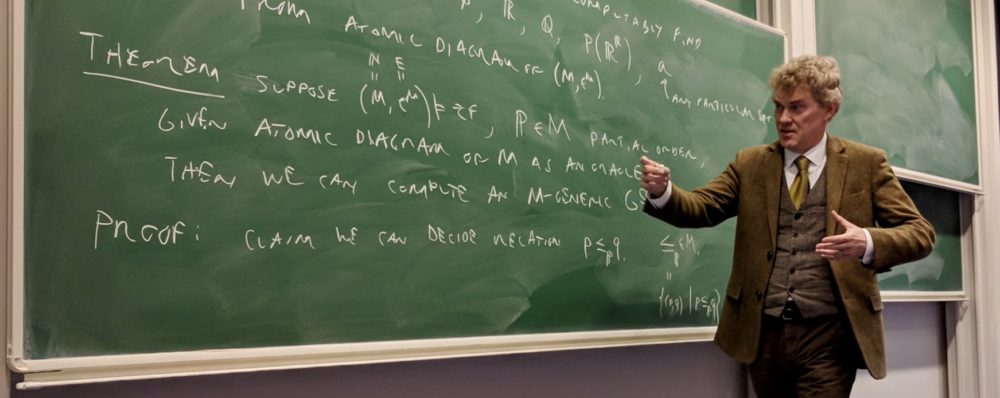
This talk will be about a generalization of the concept of Turing degrees to the hierarchy of equivalence relations on $\mathbb{N}$ under computable reducibility.  The idea is to develop a computable analogue of the enormously successful theory of equivalence relations on $\mathbb{R}$ under Borel reducibility, a theory which has led to deep insights on the complexity hierarchy of classification problems arising throughout mathematics. In the computable analogue, we consider the corresponding reduction notion in the context of Turing computability for relations on $\mathbb{N}$.  Specifically, one relation $E$ is computably reducible to another, $F$, if there is a computable function $f$ such that $x\mathrel{E} y$ if and only if $f(x)\mathrel{F} f(y)$.  This is a very different concept from mere Turing reducibility of $E$ to $F$, for it sheds light on the comparative difficulty of the classification problems corresponding to $E$ and $F$, rather than on the difficulty of computing the relations themselves.  In particular, the theory appears well suited for an analysis of equivalence relations on classes of c.e. structures, a rich context with many natural examples, such as the isomorphism relation on c.e. graphs or on computably presented groups. In this regard, our exposition extends earlier work in the literature concerning the classification of computable structures. An abundance of open questions remain.  This is joint work with Sam Coskey and Russell Miller.

articleslides | abstract on conference web page | related talk Florida MAMLS 2012 | Sam’s post on this topic

Panel discussion on the unity and diversity of logic, New York, March 2012

As a part of the Spring 2012 Mid-Atlanatic Mathematical Logic Seminar, to be held March 9-10, 2012 at the CUNY Graduate Center, I shall participate in the following panel discussion.

Panel discussion: The unity and diversity of logic

Abstract.  The field of mathematical logic sometimes seems to be fracturing into ever-finer subdisciplines, with little connection between them, and many logicians now identify themselves by their specific subdiscipline.  On the other hand, certain new themes have appeared which tend to unify the diverse discoveries of the many subdisciplines.  This discussion will address these trends and ask whether one is likely to dominate the other in the long term.  Will logic remain a single field, or will it split into many unrelated branches?

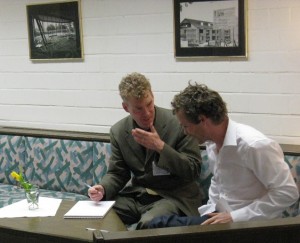
The panelists will be Prof. Gregory Cherlin, myself, Prof. Rohit Parikh, and Prof. Jouko Väänänen, with the discussion moderated by Prof. Russell Miller. Questions and participation from the audience are encouraged.

As preparation for this panel discussion, please suggest points or topics that might brought up at the panel discussion, by posting suitable comments below.  Perhaps we’ll proceed with our own pre-discussion discussion here!

The hierarchy of equivalence relations on $\mathbb{N}$ under computable reducibility, Florida, 2012

This is a talk at the Alan Turing centenary conference at Florida Atlantic University, January 13-15, 2012, sponsored by MAMLS, and part of the 2012 Alan Turing Year of events in celebration of the one hundredth year of the birth of Alan Turing.

This talk will be about a recent generalization of the concept of Turing degrees to the hierarchy of equivalence relations on $\mathbb{N}$ under computable reducibility.  The idea is to develop a computable analogue of the enormously successful theory of equivalence relations on $\mathbb{R}$ under Borel reducibility, a theory which has led to deep insights on the complexity hierarchy of classification problems arising throughout mathematics. In our computable analogue, we consider the corresponding reduction notion in the context of Turing computability for relations on $\mathbb{N}$.  Specifically, one relation $E$ is computably reducible to another, $F$, if there is a computable function $f$ such that $x\mathrel{E} y$ if and only if $f(x)\mathrel{F} f(y)$.  This is a very different concept from mere Turing reducibility of $E$ to $F$, for it sheds light on the comparative difficulty of the classification problems corresponding to $E$ and $F$, rather than on the difficulty of computing the relations themselves.  In particular, the theory appears well suited for an analysis of equivalence relations on classes of c.e. structures, a rich context with many natural examples, such as the isomorphism relation on c.e. graphs or on computably presented groups. In this regard, our exposition extends earlier work in the literature concerning the classification of computable structures. An abundance of open questions remain.  This is joint work with Sam Coskey and Russell Miller.

Article | Sam’s post on this topic | Slides

Set theory: universe or multiverse? Vienna, 2011

This talk was held as part of the Logic Cafe series at the Institute of Philosophy at the University of Vienna, October 31, 2011.

A traditional Platonist view in set theory, what I call the universe view, holds that there is an absolute background concept of set and a corresponding absolute background set-theoretic universe in which every set-theoretic assertion has a final, definitive truth value. On the multiverse view, in constrast, there are many distinct concepts of set, each instantiated in a corresponding set-theoretic universe, and a corresponding pluralism of set-theoretic truths. In this talk, after framing the debate, I shall argue that the multiverse position explains our experience with the enormous diversity of set-theoretic possibilities, a phenomenon that challenges the universe view. In particular, I shall argue that the continuum hypothesis is settled on the multiverse view by our extensive knowledge about how it behaves in the multiverse, and as a result it can no longer be settled in the manner formerly hoped for.

Slides | Article | Logic Cafe, Uni. Wien

Must there be non-definable numbers? Pointwise definability and the math-tea argument, KGRC, Vienna 2011

This talk will be a part of the “Advanced Introduction” series for graduate students at the the Kurt Gödel Research Center, November 4, 2011.

An old argument, heard perhaps at math tea, proceeds: “there must be some real numbers that we can neither describe nor define, since there are uncountably many reals, but only countably many definitions.” Does it withstand scrutiny? In this talk, I will discuss the phenomenon of pointwise definable models of set theory, in which every object is definable without parameters. In addition to classical and folklore results on the existence of pointwise definable models of set theory, the main new theorem is that every countable model of ZFC and indeed of GBC has an extension to a model of set theory with the same ordinals, in which every set and class is definable without parameters. This is joint work with Jonas Reitz and David Linetsky, and builds on work of S. Simpson, R. Kossak, J. Schmerl, S. Friedman and A. Enayat.

Slides | Article

Generalizations of the Kunen inconsistency, KGRC, Vienna 2011

This is a talk at the research seminar of the Kurt Gödel Research Center, November 3, 2011.

I shall present several generalizations of the well-known Kunen inconsistency that there is no nontrivial elementary embedding from the set-theoretic universe V to itself, including generalizations-of-generalizations previously established by Woodin and others.  For example, there is no nontrivial elementary embedding from the universe V to a set-forcing extension V[G], or conversely from V[G] to V, or more generally from one ground model of the universe to another, or between any two models that are eventually stationary correct, or from V to HOD, or conversely from HOD to V, or from V to the gHOD, or conversely from gHOD to V; indeed, there can be no nontrivial elementary embedding from any definable class to V.  Other results concern generic embeddings, definable embeddings and results not requiring the axiom of choice.  I will aim for a unified presentation that weaves together previously known unpublished or folklore results along with some new contributions.  This is joint work with Greg Kirmayer and Norman Perlmutter.

Slides | Article

The set-theoretical multiverse: a natural context for set theory, Japan 2009

Joel David Hamkins, “The Set-theoretic Multiverse : A Natural Context for Set Theory”, Annals of the Japan Association for Philosophy of Science, ISSN 0453-0691, the Japan Association for Philosophy of Science, 2011, vol 19, 37055. DOI:10.4288/jafpos.19.0_37

This article is based on a talk I gave at the conference in honor of the retirement of Yuzuru Kakuda in Kobe, Japan, March 7, 2009. I would like to express my gratitude to Kakuda-sensei and the rest of the logic group in Kobe for the opportunities provided to me to participate in logic in Japan. In particular, my time as a JSPS Fellow in the logic group at Kobe University in 1998 was a formative experience. I was part of a vibrant research group in Kobe; I enjoyed Japanese life, learned to speak a little Japanese and made many friends. Mathematically, it was a productive time, and after years away how pleasant it is for me to see that ideas planted at that time, small seedlings then, have grown into tall slender trees.

Set theorists often take their subject as constituting a foundation for the rest of mathematics, in the sense that other abstract mathematical objects can be construed fundamentally as sets. In this way, they regard the set-theoretic universe as the universe of all mathematics. And although many set-theorists affirm the Platonic view that there is just one universe of all sets, nevertheless the most powerful set-theoretic tools developed over the past half century are actually methods of constructing alternative universes. With forcing and other methods, we can now produce diverse models of ZFC set theory having precise, exacting features. The fundamental object of study in set theory has thus become the model of set theory, and the subject consequently begins to exhibit a category-theoretic second-order nature. We have a multiverse of set-theoretic worlds, connected by forcing and large cardinal embeddings like constellations in a dark sky. In this article, I will discuss a few emerging developments illustrating this second-order nature. The work engages pleasantly with various philosophical views on the nature of mathematical existence.


The Ground Axiom

[bibtex key=Hamkins2005:TheGroundAxiom]

This is an extended abstract for a talk I gave at the 2005 Workshop in Set Theory at the Mathematisches Forschungsinstitut Oberwolfach.

Oberwolfach Research Report 55/2005 | Ground Axiom on Wikipedia

The multiverse perspective on determinateness in set theory, Harvard, 2011

This talk, taking place October 19, 2011, is part of the year-long Exploring the Frontiers of Incompleteness (EFI) series at Harvard University, a workshop focused on the question of determinateness in set theory, a central question in the philosophy of set theory. JDH at Harvard Streaming video will be available on-line, and each talk will be associated with an on-line discussion forum, to which links will be made here later.

In this talk, I will discuss the multiverse perspective on determinateness in set theory.  The multiverse view in set theory is the view that there are many distinct concepts of set, each instantiated in a corresponding set-theoretic universe. The universe view, in contrast, asserts that there is an absolute background set concept, with a corresponding absolute set-theoretic universe in which every set-theoretic question has a definite answer.  The multiverse position, I argue, explains our experience with the enormous diversity of set-theoretic possibilities, a phenomenon that challenges the universe view.  In particular, I shall argue that the continuum hypothesis is settled on the multiverse view by our extensive knowledge about how it behaves in the multiverse, and as a result it can no longer be settled in the manner formerly hoped for.

Workshop materials | Article | Slides | EFI discussion forum | Video Stream

The multiverse view in set theory, Singapore 2011

A talk at the Asian Initive for Infinity: Workshop on Infinity and Truth, July 25-29, 2011, National University of Singapore.

I shall outline and defend the Multiverse view in set theory, the view that there are many set-theoretic universes, each instantiating its own concept of set, and contrast it with the Universe view, the view that there is an absolute background set-theoretic universe.  In addition, I will discuss some recent set-theoretic developments that have been motivated and informed by a multiverse perspective, including the modal logic of forcing and the emergence of set-theoretic geology.

Slides  |  Article

Generalizations of the Kunen Inconsistency, Singapore 2011

A talk at the Prospects of Infinity: Workshop on Set Theory  at the National University of Singapore, July 18-22, 2011.

I shall present several generalizations of the well-known Kunen inconsistency that there is no nontrivial elementary embedding from the set-theoretic universe V to itself, including generalizations-of-generalizations previously established by Woodin and others.  For example, there is no nontrivial elementary embedding from the universe V to a set-forcing extension V[G], or conversely from V[G] to V, or more generally from one ground model of the universe to another, or between any two models that are eventually stationary correct, or from V to HOD, or conversely from HOD to V, or from V to the gHOD, or conversely from gHOD to V; indeed, there can be no nontrivial elementary embedding from any definable class to V.  Other results concern generic embeddings, definable embeddings and results not requiring the axiom of choice.  I will aim for a unified presentation that weaves together previously known unpublished or folklore results along with some new contributions.  This is joint work with Greg Kirmayer and Norman Perlmutter.

SlidesArticle 

The modal logic of forcing, London 2011

A talk at the conference on Set Theory and Higher-Order Logic: Foundational Issues and Mathematical Developments, following the summer school, at the University of London, Birkbeck, July 1-6, 2011.

What are the most general principles relating forceability and truth? As in Solovay’s celebrated analysis of provability, this question and its answer are naturally formulated in modal logic. Specifically, we de ne that a set theoretic assertion phi is forceable or possible if it holds in some forcing extension, and necessary if it holds in all forcing extensions. Under this forcing interpretation, the provably valid principles of forcing are exactly those in the modal theory known as S4.2. In this talk, I shall discuss this result and recent advances in this area. This is joint work with Benedikt Loewe.

See article at: The modal logic of forcing.


A tutorial in set-theoretic geology, London 2011

A three-lecture mini-course tutorial in set-theoretic geology at the summer school Set Theory and Higher-Order Logic: Foundational Issues and Mathematical Developments, August 1-6, 2011, University of London, Birkbeck.

The technique of forcing in set theory is customarily thought of as a method for constructing outer as opposed to inner models of set theory; one starts in a ground model V and considers the possible forcing extensions V[G] of it. A simple switch in perspective, however, allows us to use forcing to describe inner models, by considering how a given universe V may itself have arisen by forcing. This change in viewpoint leads to the topic of set-theoretic geology, aiming to investigate the structure and properties of the ground models of the universe. In this tutorial, I shall present some of the most interesting initial results in the topic, along with an abundance of open questions, many of which concern fundamental issues.

A ground of the universe V is an inner model W of ZFC over which the universe V=W[G] is a forcing extension. The model V satisfies the Ground Axiom of there are no such W properly contained in V. The model W is a bedrock of V if it is a ground of V and satisfies the Ground Axiom. The mantle of V is the intersection of all grounds of V, and the generic mantle is the intersection of all grounds of all set-forcing extensions. The generic HOD, written gHOD, is the intersection of all HODs of all set-forcing extensions. The generic HOD is always a model of ZFC, and the generic mantle is always a model of ZF. Every model of ZFC is the mantle and generic mantle of another model of ZFC, and this can be proved while also controlling the HOD of the final model, as well as the generic HOD. Iteratively taking the mantle penetrates down through the inner mantles to the outer core, what remains when all outer layers of forcing have been stripped away. Many fundamental questions remain open.

  Article

What is the theory of ZFC-Powerset? Toronto 2011

This was a talk at the Toronto Set Theory Seminar held April 22, 2011 at the Fields Institute in Toronto.

The theory ZFC-, consisting of the usual axioms of ZFC but with the powerset axiom removed, when axiomatized by extensionality, foundation, pairing, union, infinity, separation, replacement and the axiom of choice, is weaker than commonly supposed, and suffices to prove neither that a countable union of countable sets is countable, nor that $\omega_1$ is regular, nor that the Los theorem holds for ultrapowers, even for well-founded ultrapowers on a measurable cardinal, nor that the Gaifman theorem holds, that is, that every $\Sigma_1$-elementary cofinal embedding $j:M\to N$ between models of the theory is fully elementary, nor that $\Sigma_n$ sets are closed under bounded quantification. Nevertheless, these deficits of ZFC- are completely repaired by strengthening it to the theory obtained by using the collection axiom rather than replacement in the axiomatization above. These results extend prior work of Zarach. This is joint work with Victoria Gitman and Thomas Johnstone.

Article | Victoria Gitman’s post

An introduction to Boolean ultrapowers, Bonn, 2011

A four-lecture tutorial on the topic of Boolean ultrapowers at the Young Set Theory Workshop at the Hausdorff Center for Mathematics in Königswinter near Bonn, Germany,  March 21-25, 2011.

Boolean ultrapowers generalize the classical ultrapower construction on a power-set algebra to the context of an ultrafilter on an arbitrary complete Boolean algebra. Closely related to forcing and particularly to the use of Boolean-valued models in forcing, Boolean ultrapowers were introduced by Vopenka in order to carry out forcing as an internal ZFC construction, rather than as a meta-theoretic argument as in Cohen’s approach. An emerging interest in Boolean ultrapowers has arisen from a focus on the well-founded Boolean ultrapowers as large cardinal embeddings.

Historically, researchers have come to the Boolean ultrapower concept from two directions, from set theory and from model theory. Exemplifying the set-theoretic perspective, Bell’s classic (1985) exposition emphasizes the Boolean-valued model $V^{\mathbb{B}}$ and its quotients $V^{\mathbb{B}}/U$, rather than the Boolean ultrapower $V_U$ itself, which is not considered there. Mansfield (1970), in contrast, gives a purely algebraic, forcing-free account of the Boolean ultrapower, emphasizing its potential as a model-theoretic technique, while lacking the accompanying generic objects.

The unifying view I will explore in this tutorial is that the well-founded Boolean ultrapowers reveal the two central concerns of set-theoretic research–forcing and large cardinals–to be two aspects of a single underlying construction, the Boolean ultrapower, whose consequent close connections might be more fruitfully explored. I will provide a thorough introduction to the Boolean ultrapower construction, while assuming only an elementary graduate student-level familiarity with set theory and the classical ultrapower and forcing techniques.

ArticleAbstract | Lecture Notes