Categorical large cardinals and the tension between categoricity and set-theoretic reflection

[bibtex key=”HamkinsSolberg:Categorical-large-cardinals”]

Abstract. Inspired by Zermelo’s quasi-categoricity result characterizing the models of second-order Zermelo-Fraenkel set theory $\text{ZFC}_2$, we investigate when those models are fully categorical, characterized by the addition to $\text{ZFC}_2$ either of a first-order sentence, a first-order theory, a second-order sentence or a second-order theory. The heights of these models, we define, are the categorical large cardinals. We subsequently consider various philosophical aspects of categoricity for structuralism and realism, including the tension between categoricity and set-theoretic reflection, and we present (and criticize) a categorical characterization of the set-theoretic universe $\langle V,\in\rangle$ in second-order logic.

Categorical accounts of various mathematical structures lie at the very core of structuralist mathematical practice, enabling mathematicians to refer to specific mathematical structures, not by having carefully to prepare and point at specially constructed instances—preserved like the one-meter iron bar locked in a case in Paris—but instead merely by mentioning features that uniquely characterize the structure up to isomorphism.

The natural numbers $\langle \mathbb{N},0,S\rangle$, for example, are uniquely characterized by the Dedekind axioms, which assert that $0$ is not a successor, that the successor function $S$ is one-to-one, and that every set containing $0$ and closed under successor contains every number. We know what we mean by the natural numbers—they have a definite realness—because we can describe features that completely determine the natural number structure. The real numbers $\langle\mathbb{R},+,\cdot,0,1\rangle$ similarly are characterized up to isomorphism as the unique complete ordered field. The complex numbers $\langle\mathbb{C},+,\cdot\rangle$ form the unique algebraically closed field of characteristic $0$ and size continuum, or alternatively, the unique algebraic closure of the real numbers. In fact all our fundamental mathematical structures enjoy such categorical characterizations, where a theory is categorical if it identifies a unique mathematical structure up to isomorphism—any two models of the theory are isomorphic. In light of the Löwenheim-Skolem theorem, which prevents categoricity for infinite structures in first-order logic, these categorical theories are generally made in second-order logic.

In set theory, Zermelo characterized the models of second-order Zermelo-Fraenkel set theory $\text{ZFC}_2$ in his famous quasi-categoricity result:

Theorem. (Zermelo, 1930) The models of $\text{ZFC}_2$ are precisely those isomorphic to a rank-initial segment $\langle V_\kappa,\in\rangle$ of the cumulative set-theoretic universe $V$ cut off at an inaccessible cardinal $\kappa$.

It follows that for any two models of $\text{ZFC}_2$, one of them is isomorphic to an initial segment of the other. These set-theoretic models $V_\kappa$ have now come to be known as Zermelo-Grothendieck universes, in light of Grothendieck’s use of them in category theory (a rediscovery several decades after Zermelo); they feature in the universe axiom, which asserts that every set is an element of some such $V_\kappa$, or equivalently, that there are unboundedly many inaccessible cardinals.

In this article, we seek to investigate the extent to which Zermelo’s quasi-categoricity analysis can rise fully to the level of categoricity, in light of the observation that many of the $V_\kappa$ universes are categorically characterized by their sentences or theories.

Question. Which models of $\text{ZFC}_2$ satisfy fully categorical theories?

If $\kappa$ is the smallest inaccessible cardinal, for example, then up to isomorphism $V_\kappa$ is the unique model of $\text{ZFC}_2$ satisfying the first-order sentence “there are no inaccessible cardinals.” The least inaccessible cardinal is therefore an instance of what we call a first-order sententially categorical cardinal. Similar ideas apply to the next inaccessible cardinal, and the next, and so on for quite a long way. Many of the inaccessible universes thus satisfy categorical theories extending $\text{ZFC}_2$ by a sentence or theory, either in first or second order, and we should like to investigate these categorical extensions of $\text{ZFC}_2$.

In addition, we shall discuss the philosophical relevance of categoricity and point particularly to the philosophical problem posed by the tension between the widespread support for categoricity in our fundamental mathematical structures with set-theoretic ideas on reflection principles, which are at heart anti-categorical.

Our main theme concerns these notions of categoricity:

Main Definition.

  • A cardinal $\kappa$ is first-order sententially categorical, if there is a first-order sentence $\sigma$ in the language of set theory, such that $V_\kappa$ is categorically characterized by $\text{ZFC}_2+\sigma$.
  • A cardinal $\kappa$ is first-order theory categorical, if there is a first-order theory $T$ in the language of set theory, such that $V_\kappa$ is categorically characterized by $\text{ZFC}_2+T$.
  • A cardinal $\kappa$ is second-order sententially categorical, if there is a second-order sentence $\sigma$ in the language of set theory, such that $V_\kappa$ is categorically characterized by $\text{ZFC}_2+\sigma$.
  • A cardinal $\kappa$ is second-order theory categorical, if there is a second-order theory $T$ in the language of set theory, such that $V_\kappa$ is categorically characterized by $\text{ZFC}_2+T$.

Follow through to the arxiv for the pdf to read more:

[bibtex key=”HamkinsSolberg:Categorical-large-cardinals”]

Related talk: Categorical cardinals, CUNY Set Theory Seminar, June 2020

The otherwordly cardinals

I’d like to introduce and discuss the otherworldly cardinals, a large cardinal notion that frequently arises in set-theoretic analysis, but which until now doesn’t seem yet to have been given its own special name. So let us do so here.

I was put on to the topic by Jason Chen, a PhD student at UC Irvine working with Toby Meadows, who brought up the topic recently on Twitter:

In response, I had suggested the otherworldly terminology, a play on the fact that the two cardinals will both be worldly, and so we have in essence two closely related worlds, looking alike. We discussed the best way to implement the terminology and its extensions. The main idea is the following:

Main Definition. An ordinal $\kappa$ is otherworldly if $V_\kappa\prec V_\lambda$ for some ordinal $\lambda>\kappa$. In this case, we say that $\kappa$ is otherworldly to $\lambda$.

It is an interesting exercise to see that every otherworldly cardinal $\kappa$ is in fact also worldly, which means $V_\kappa\models\text{ZFC}$, and from this it follows that $\kappa$ is a strong limit cardinal and indeed a $\beth$-fixed point and even a $\beth$-hyperfixed point and more.

Theorem. Every otherworldly cardinal is also worldly.

Proof. Suppose that $\kappa$ is otherworldly, so that $V_\kappa\prec V_\lambda$ for some ordinal $\lambda>\kappa$. It follows that $\kappa$ must in fact be a cardinal, since otherwise it would be the order type of a relation on a set in $V_\kappa$, which would be isomorphic to an ordinal in $V_\lambda$ but not in $V_\kappa$. And since $\omega$ is not otherworldly, we see that $\kappa$ must be an uncountable cardinal. Since $V_\kappa$ is transitive, we get now easily that $V_\kappa$ satisfies extensionality, regularity, union, pairing, power set, separation and infinity. The only axiom remaining is replacement. If $\varphi(a,b)$ obeys a functional relation in $V_\kappa$ for all $a\in A$, where $A\in V_\kappa$, then $V_\lambda$ agrees with that, and also sees that the range is contained in $V_\kappa$, which is a set in $V_\lambda$. So $V_\kappa$ agrees that the range is a set. So $V_\kappa$ fulfills the replacement axiom. $\Box$

Corollary. A cardinal is otherworldly if and only if it is fully correct in a worldly cardinal.

Proof. Once you know that otherworldly cardinals are worldly, this amounts to a restatement of the definition. If $V_\kappa\prec V_\lambda$, then $\lambda$ is worldly, and $V_\kappa$ is correct in $V_\lambda$. $\Box$

Let me prove next that whenever you have an otherworldly cardinal, then you will also have a lot of worldly cardinals, not just these two.

Theorem. Every otherworldly cardinal $\kappa$ is a limit of worldly cardinals. What is more, every otherworldly cardinal is a limit of worldly cardinals having exactly the same first-order theory as $V_\kappa$, and indeed, the same $\alpha$-order theory for any particular $\alpha<\kappa$.

Proof. If $V_\kappa\prec V_\lambda$, then $V_\lambda$ can see that $\kappa$ is worldly and has the theory $T$ that it does. So $V_\lambda$ thinks, about $T$, that there is a cardinal whose rank initial segment has theory $T$. Thus, $V_\kappa$ also thinks this. And we can find arbitrarily large $\delta$ up to $\kappa$ such that $V_\delta$ has this same theory. This argument works whether one uses the first-order theory, or the second-order theory or indeed the $\alpha$-order theory for any $\alpha<\kappa$. $\Box$

Theorem. If $\kappa$ is otherworldly, then for every ordinal $\alpha<\kappa$ and natural number $n$, there is a cardinal $\delta<\kappa$ with $V_\delta\prec_{\Sigma_n}V_\kappa$ and the $\alpha$-order theory of $V_\delta$ is the same as $V_\kappa$.

Proof. One can do the same as above, since $V_\lambda$ can see that $V_\kappa$ has the $\alpha$-order theory that it does, while also agreeing on $\Sigma_n$ truth with $V_\lambda$, so $V_\kappa$ will agree that there should be such a cardinal $\delta<\kappa$. $\Box$

Definition. We say that a cardinal is totally otherworldly, if it is otherworldly to arbitrarily large ordinals. It is otherworldly beyond $\theta$, if it is otherworldly to some ordinal larger than $\theta$. It is otherworldly up to $\delta$, if it is otherworldly to ordinals cofinal in $\delta$.

Theorem. Every inaccessible cardinal $\delta$ is a limit of otherworldly cardinals that are each otherworldly up to and to $\delta$.

Proof. If $\delta$ is inaccessible, then a simple Löwenheim-Skolem construction shows that $V_\kappa$ is the union of a continuous elementary chain $$V_{\kappa_0}\prec V_{\kappa_1}\prec\cdots\prec V_{\kappa_\alpha}\prec \cdots \prec V_\kappa$$ Each of the cardinals $\kappa_\alpha$ arising on this chain is otherworldly up to and to $\delta$. $\Box$

Theorem. Every totally otherworldly cardinal is $\Sigma_2$ correct, meaning $V_\kappa\prec_{\Sigma_2} V$. Consequently, every totally otherworldly cardinal is larger than the least measurable cardinal, if it exists, and larger than the least superstrong cardinal, if it exists, and larger than the least huge cardinal, if it exists.

Proof. Every $\Sigma_2$ assertion is locally verifiable in the $V_\alpha$ hierarchy, in that it is equivalent to an assertion of the form $\exists\eta V_\eta\models\psi$ (for more information, see my post about Local properties in set theory). Thus, every true $\Sigma_2$ assertion is revealed inside any sufficiently large $V_\lambda$, and so if $V_\kappa\prec V_\lambda$ for arbitrarily large $\lambda$, then $V_\kappa$ will agree on those truths. $\Box$

I was a little confused at first about how two totally otherwordly cardinals interact, but now everything is clear with this next result. (Thanks to Hanul Jeon for his helpful comment below.)

Theorem. If $\kappa<\delta$ are both totally otherworldly, then $\kappa$ is otherworldly up to $\delta$, and hence totally otherworldly in $V_\delta$.

Proof. Since $\delta$ is totally otherworldly, it is $\Sigma_2$ correct. Since for every $\alpha<\delta$ the cardinal $\kappa$ is otherworldly beyond $\alpha$, meaning $V_\kappa\prec V_\lambda$ for some $\lambda>\alpha$, then since this is a $\Sigma_2$ feature of $\kappa$, it must already be true inside $V_\delta$. So such a $\lambda$ can be found below $\delta$, and so $\kappa$ is otherworldly up to $\delta$. $\Box$

Theorem. If $\kappa$ is totally otherworldly, then $\kappa$ is a limit of otherworldly cardinals, and indeed, a limit of otherworldly cardinals having the same theory as $V_\kappa$.

Proof. Assume $\kappa$ is totally otherworldly, let $T$ be the theory of $V_\kappa$, and consider any $\alpha<\kappa$. Since there is an otherworldly cardinal above $\alpha$ with theory $T$, namely $\kappa$, and because this is a $\Sigma_2$ fact about $\alpha$ and $T$, it follows that there must be such a cardinal above $\alpha$ inside $V_\kappa$. So $\kappa$ is a limit of otherworldly cardinals with the same theory as $V_\kappa$. $\Box$

The results above show that the consistency strength of the hypotheses are ordered as follows, with strict increases in consistency strength as you go up (assuming consistency):

  • ZFC + there is an inaccessible cardinal
  • ZFC + there is a proper class of totally otherworldly cardinals
  • ZFC + there is a totally otherworldly cardinal
  • ZFC + there is a proper class of otherworldly cardinals
  • ZFC + there is an otherworldly cardinal
  • ZFC + there is a proper class of worldly cardinals
  • ZFC + there is a worldly cardinal
  • ZFC + there is a transitive model of ZFC
  • ZFC + Con(ZFC)
  • ZFC

We might consider the natural strengthenings of otherworldliness, where one wants $V_\kappa\prec V_\lambda$ where $\lambda$ is itself otherworldly. That is, $\kappa$ is the beginning of an elementary chain of three models, not just two. This is different from having merely that $V_\kappa\prec V_\lambda$ and $V_\kappa\prec V_\eta$ for some $\eta>\lambda$, because perhaps $V_\lambda$ is not elementary in $V_\eta$, even though $V_\kappa$ is. Extending successively is a more demanding requirement.

One then naturally wants longer and longer chains, and ultimately we find ourselves considering various notions of rank in the rank elementary forest, which is the relation $\kappa\preceq\lambda\iff V_\kappa\prec V_\lambda$. The otherworldly cardinals are simply the non-maximal nodes in this order, while it will be interesting to consider the nodes that can be extended to longer elementary chains.

Modal model theory as mathematical potentialism, Oslo online Potentialism Workshop, September 2020

This will be a talk for the Oslo potentialism workshop, Varieties of Potentialism, to be held online via Zoom on 23 September 2020, from noon to 18:40 CEST (11am to 17:40 UK time). My talk is scheduled for 13:10 CEST (12:10 UK time). Further details about access and registration are availavle on the conference web page.

Abstract. I shall introduce and describe the subject of modal model theory, in which one studies a mathematical structure within a class of similar structures under an extension concept, giving rise to mathematically natural notions of possibility and necessity, a form of mathematical potentialism. We study the class of all graphs, or all groups, all fields, all orders, or what have you; a natural case is the class $\text{Mod}(T)$ of all models of a fixed first-order theory $T$. In this talk, I shall describe some of the resulting elementary theory, such as the fact that the $\mathcal{L}$ theory of a structure determines a robust fragment of its modal theory, but not all of it. The class of graphs illustrates the remarkable power of the modal vocabulary, for the modal language of graph theory can express connectedness, colorability, finiteness, countability, size continuum, size $\aleph_1$, $\aleph_2$, $\aleph_\omega$, $\beth_\omega$, first $\beth$-fixed point, first $\beth$-hyper-fixed-point and much more. When augmented with the actuality operator @, modal graph theory becomes fully bi-interpretable with truth in the set-theoretic universe. This is joint work with Wojciech Wołoszyn.

Corey Bacal Switzer, PhD 2020, CUNY Graduate Center

Dr. Corey Bacal Switzer successfully defended his PhD dissertation, entitled “Alternative Cichoń Diagrams and Forcing Axioms Compatible with CH,” on 31 July 2020, for the degree of PhD from The Graduate Center of the City University of New York. The dissertation was supervised jointly by myself and Gunter Fuchs.

Corey has now accepted a three-year post-doctoral research position at the University of Vienna, where he will be working with Vera Fischer.

Corey Bacal Switzer | arXiv.org | Google scholar | dissertation

Abstract. This dissertation surveys several topics in the general areas of iterated forcing, infinite combinatorics and set theory of the reals. There are four largely independent chapters, the first two of which consider alternative versions of the Cichoń diagram and the latter two consider forcing axioms compatible with CH . In the first chapter, I begin by introducing the notion of a reduction concept , generalizing various notions of reduction in the literature and show that for each such reduction there is a Cichoń diagram for effective cardinal characteristics relativized to that reduction. As an application I investigate in detail the Cichoń diagram for degrees of constructibility relative to a fixed inner model $W\models\text{ZFC}$.

In the second chapter, I study the space of functions $f:\omega^\omega\to\omega^\omega$ and introduce 18 new higher cardinal characteristics associated with this space. I prove that these can be organized into two diagrams of 6 and 12 cardinals respecitvely analogous to the Cichoń diagram on $\omega$. I then investigate their relation to cardinal invariants on ω and introduce several new forcing notions for proving consistent separations between the cardinals. The third chapter concerns Jensen’s subcomplete and subproper forcing. I generalize these notions to the (seemingly) larger classes of ∞-subcomplete and ∞-subproper. I show that both classes are (apparently) much more nicely behaved structurally than their non-∞-counterparts and iteration theorems are proved for both classes using Miyamoto’s nice iterations. Several preservation theorems are then presented. This includes the preservation of Souslin trees, the Sacks property, the Laver property, the property of being $\omega^\omega$-bounding and the property of not adding branches to a given $\omega_1$-tree along nice iterations of ∞-subproper forcing notions. As an application of these methods I produce many new models of the subcomplete forcing axiom, proving that it is consistent with a wide variety of behaviors on the reals and at the level of $\omega_1$.

The final chapter contrasts the flexibility of SCFA with Shelah’s dee-complete forcing and its associated axiom DCFA . Extending a well known result of Shelah, I show that if a tree of height $\omega_1$ with no branch can be embedded into an $\omega_1$-tree, possibly with branches, then it can be specialized without adding reals. As a consequence I show that DCFA implies there are no Kurepa trees, even if CH fails.

Choiceless large cardinals and set-theoretic potentialism

[bibtex key=”CutoloHamkins:Choiceless-large-cardinals-and-set-theoretic-potentialism”]

Abstract. We define a potentialist system of ZF-structures, that is, a collection of possible worlds in the language of ZF connected by a binary accessibility relation, achieving a potentialist account of the full background set-theoretic universe $V$. The definition involves Berkeley cardinals, the strongest known large cardinal axioms, inconsistent with the Axiom of Choice. In fact, as background theory we assume just ZF. It turns out that the propositional modal assertions which are valid at every world of our system are exactly those in the modal theory S4.2. Moreover, we characterize the worlds satisfying the potentialist maximality principle, and thus the modal theory S5, both for assertions in the language of ZF and for assertions in the full potentialist language.

Forcing as a computational process

[bibtex key=”HamkinsMillerWilliams:Forcing-as-a-computational-process”]

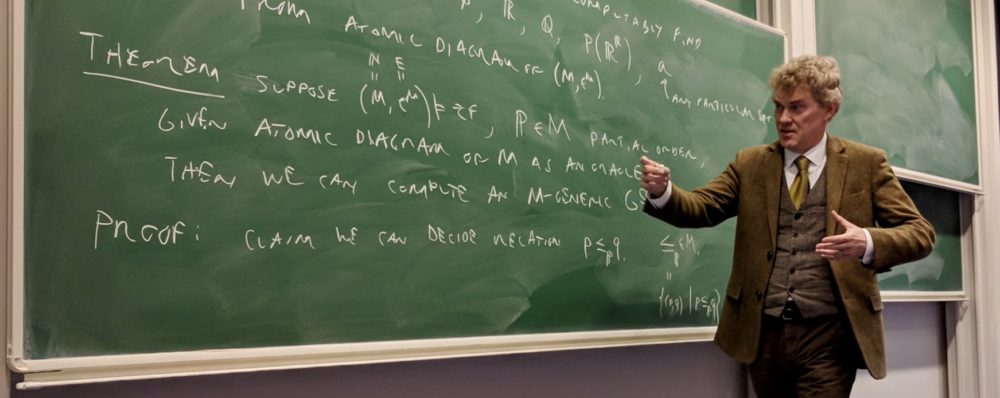
Abstract. We investigate how set-theoretic forcing can be seen as a computational process on the models of set theory. Given an oracle for information about a model of set theory $\langle M,\in^M\rangle$, we explain senses in which one may compute $M$-generic filters $G\subseteq\mathbb{P}\in M$ and the corresponding forcing extensions $M[G]$. Specifically, from the atomic diagram one may compute $G$, from the $\Delta_0$-diagram one may compute $M[G]$ and its $\Delta_0$-diagram, and from the elementary diagram one may compute the elementary diagram of $M[G]$. We also examine the information necessary to make the process functorial, and conclude that in the general case, no such computational process will be functorial. For any such process, it will always be possible to have different isomorphic presentations of a model of set theory $M$ that lead to different non-isomorphic forcing extensions $M[G]$. Indeed, there is no Borel function providing generic filters that is functorial in this sense.

Categorical cardinals, CUNY Set Theory Seminar, June 2020

This will be an online talk for the CUNY Set Theory Seminar, Friday 26 June 2020, 2 pm EST = 7 pm UK time. Contact Victoria Gitman for Zoom access. 

Abstract: Zermelo famously characterized the models of second-order Zermelo-Fraenkel set theory $\text{ZFC}_2$ in his 1930 quasi-categoricity result asserting that the models of $\text{ZFC}_2$ are precisely those isomorphic to a rank-initial segment $V_\kappa$ of the cumulative set-theoretic universe $V$ cut off at an inaccessible cardinal $\kappa$. I shall discuss the extent to which Zermelo’s quasi-categoricity analysis can rise fully to the level of categoricity, in light of the observation that many of the $V_\kappa$ universes are categorically characterized by their sentences or theories. For example, if $\kappa$ is the smallest inaccessible cardinal, then up to isomorphism $V_\kappa$ is the unique model of $\text{ZFC}_2$ plus the sentence “there are no inaccessible cardinals.” This cardinal $\kappa$ is therefore an instance of what we call a first-order sententially categorical cardinal. Similarly, many of the other inaccessible universes satisfy categorical extensions of $\text{ZFC}_2$ by a sentence or theory, either in first or second order. I shall thus introduce and investigate the categorical cardinals, a new kind of large cardinal. This is joint work with Robin Solberg (Oxford).

My view of Univ

Appearing in The Martlet, Issue 11, Spring 2020, University College, Oxford.

My view of Univ

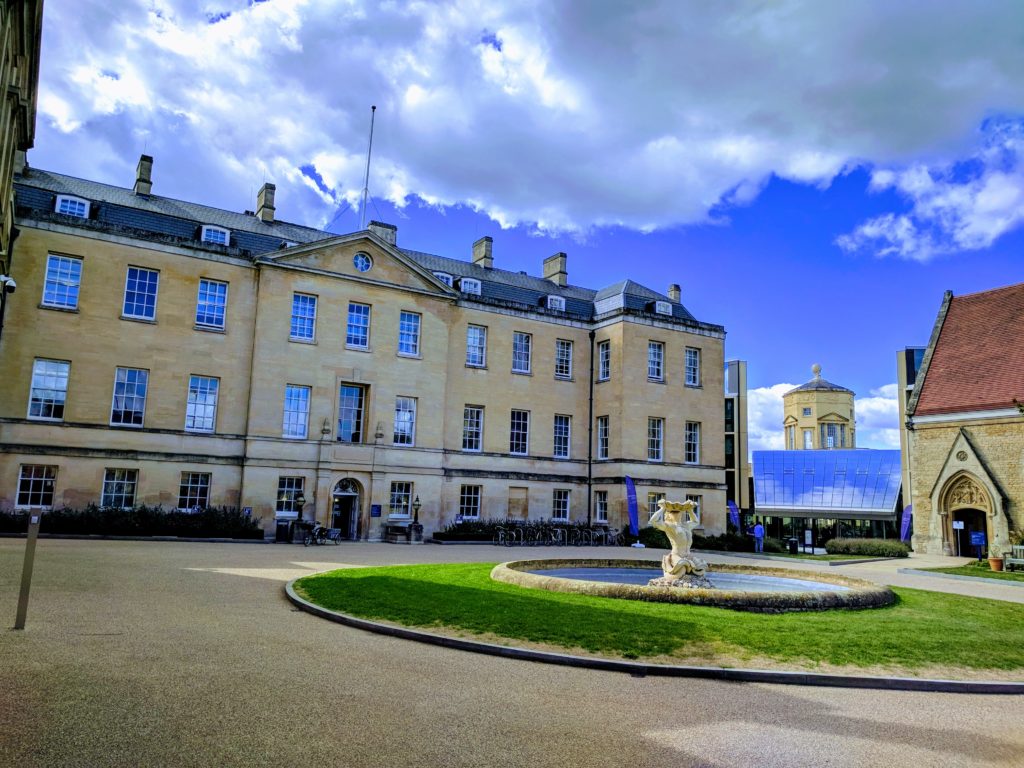
“I came to Oxford last year, leaving an established career in New York, and found a welcoming new home, an ideal environment for research and intellectual stimulation. Through the big wooden door to the Main Quad, I enter the College each day to find fascinating new conversations with historians, classicists, geologists, political scientists, medical scientists, mathematicians, philosophers, artists and even Egyptologists. What a life! I take on Oxford like a fine wool coat, enveloping me, suiting me perfectly.”


Professor Joel David Hamkins, Sir Peter Strawson Fellow in Philosophy at Univ and Professor of Logic at Oxford

The theory of infinite games, including infinite chess, Talk Math With Your Friends, June 2020

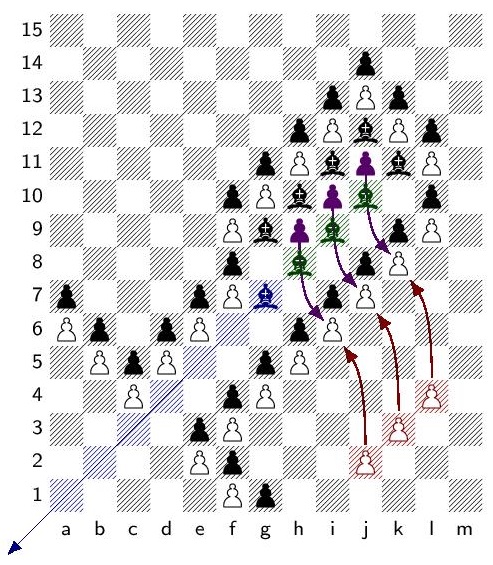
This will be accessible online talk about infinite chess and other infinite games for the Talk Math With Your Friends seminar, June 18, 2020 4 pm EST (9 pm UK).  Zoom access information.  Please come talk math with me!

Abstract. I will give an introduction to the theory of infinite games, with examples drawn from infinite chess in order to illustrate various concepts, such as the transfinite game value of a position.

See more of my posts on infinite chess.

Proof and the Art of Mathematics

A coming-of-age book for mathematicians aspiring to write proofs.

[bibtex key=”Hamkins2020:Proof-and-the-art-of-mathematics”]

Now available!

From the Preface:

This is a mathematical coming-of-age book, for students on the cusp, who are maturing into mathematicians, aspiring to communicate mathematical truths to other mathematicians in the currency of mathematics, which is: proof. This is a book for students who are learning—perhaps for the first time in a serious way—how to write a mathematical proof. I hope to show how a mathematician makes an argument establishing a mathematical truth.

Proofs tell us not only that a mathematical statement is true, but also why it is true, and they communicate this truth. The best proofs give us insight into the nature of mathematical reality. They lead us to those sublime yet elusive Aha! moments, a joyous experience for any mathematician, occurring when a previously opaque, confounding issue becomes transparent and our mathematical gaze suddenly penetrates completely through it, grasping it all in one take. So let us learn together how to write proofs well, producing clear and correct mathematical arguments that logically establish their conclusions, with whatever insight and elegance we can muster. We shall do so in the context of the diverse mathematical topics that I have gathered together here in this book for the purpose.

Bi-interpretation of weak set theories, Oxford Set Theory Seminar, May 2020

This will be a talk for the newly founded Oxford Set Theory Seminar, May 20, 2020. Contact Sam Adam-Day (me@samadamday.com) for the Zoom access codes. 

Abstract: Set theory exhibits a truly robust mutual interpretability phenomenon: in any model of one set theory we can define models of diverse other set theories and vice versa. In any model of ZFC, we can define models of ZFC + GCH and also of ZFC + ¬CH and so on in hundreds of cases. And yet, it turns out, in no instance do these mutual interpretations rise to the level of bi-interpretation. Ali Enayat proved that distinct theories extending ZF are never bi-interpretable, and models of ZF are bi-interpretable only when they are isomorphic. So there is no nontrivial bi-interpretation phenomenon in set theory at the level of ZF or above.  Nevertheless, for natural weaker set theories, we prove, including ZFC- without power set and Zermelo set theory Z, there are nontrivial instances of bi-interpretation. Specifically, there are well-founded models of ZFC- that are bi-interpretable, but not isomorphic—even $\langle H_{\omega_1},\in\rangle$ and $\langle H_{\omega_2},\in\rangle$ can be bi-interpretable—and there are distinct bi-interpretable theories extending ZFC-. Similarly, using a construction of Mathias, we prove that every model of ZF is bi-interpretable with a model of Zermelo set theory in which the replacement axiom fails. This is joint work with Alfredo Roque Freire.

This is a version of the talk that I had planned to give at the 2020 Set Theory meeting Oberwolfach, before that meeting was canceled on account of the Covid-19 situation.

Slides

Bi-interpretation in weak set theories

  • [bibtex key=”FreireHamkins:Bi-interpretation-in-weak-set-theories”]

Oxford Set Theory Seminar

Welcome to the Oxford Set Theory Seminar.

We focus on all aspects of set theory and the philosophy of set theory. Topics will include forcing, large cardinals, models of set theory, set theory as a foundation, set-theoretic potentialism, cardinal characteristics of the continuum, second-order set theory and class theory, and much more.

Technical topics are completely fine. Speakers are encouraged to pick set-theoretic topics having some philosophical angle or aspect, although it is expected that this might sometimes be a background consideration, while at other times it will be a primary focus.

The seminar will last 60-90 minutes, and are generally held on Wednesdays 4:00 – 5:30 UK time. Speakers are requested to prepare a one hour talk, and we expect a lively discussion with questions.

Trinity Term 2021

The seminar this term is again held jointly with the University of Bristol, organized by myself, Samuel Adam-Day, and Philip Welch.

For the Zoom access code, contact Samuel Adam-Day at me@samadamday.com.

19 May 2021 4:30 pm UK

Samuel Adam-Day

University of Oxford

The continuous gradability of the cut-point orders of $\newcommand\R{\mathbb{R}}\R$-trees

Abstract. An $\R$-tree is a metric space tree in which every point can be branching. Favre and Jonsson posed the following problem in 2004: can the class of orders underlying $\R$-trees be characterised by the fact that every branch is order-isomorphic to a real interval? In the first part of the talk, I answer this question in the negative: there is a branchwise-real tree order which is not continuously gradable. In the second part, I show that a branchwise-real tree order is continuously gradable if and only if every embedded well-stratified (i.e. set-theoretic) tree is $\R$-gradable. This tighter link with set theory is put to work in the third part answering a number of refinements of the main question, yielding several independence results.

26 May 2021 4:30 pm BST

Sandra Müller

TU Wien

The strength of determinacy when all sets are universally Baire

Abstract. The large cardinal strength of the Axiom of Determinacy when enhanced with the hypothesis that all sets of reals are universally Baire is known to be much stronger than the Axiom of Determinacy itself. In fact, Sargsyan conjectured it to be as strong as the existence of a cardinal that is both a limit of Woodin cardinals and a limit of strong cardinals. Larson, Sargsyan and Wilson showed that this would be optimal via a generalization of Woodin’s derived model construction. We will discuss a new translation procedure for hybrid mice extending work of Steel, Zhu and Sargsyan and use this to prove Sargsyan’s conjecture.

1 June 2021 4:30 pm BST

Christopher Turner

Bristol

Forcing Axioms and Name Principles

Abstract. Forcing axioms are a well-known way of expressing the concept ”there are filters in V which are close to being generic”. Name principles are another expression of this concept. A name principle says: ”Let $\sigma$ be any sufficiently nice name which is forced to have some property. Then there is a filter $g\in V$ such that $\sigma^g$ has that property.” Name principles have often been used on an ad-hoc basis in proofs, but have not been studied much as axioms in their own right. In this talk, I will present some of the connections between different name principles, and between name principles and forcing axioms. This is based on joint work with Philipp Schlicht.

16 June 2021 4:30 pm BST

Joan Bagaria

Barcelona

Some recent results on Structural Reflection

Abstract. The general Structural Reflection (SR) principle asserts that for every definable, in the first-order language of set theory, possibly with parameters, class $\mathcal{C}$ of relational structures of the same type there exists an ordinal $\alpha$ that reflects $\mathcal{C}$, i.e.,  for every $A$ in $\mathcal{C}$ there exists $B$ in $\mathcal{C}\cap V_\alpha$ and an elementary embedding from $B$ into $A$. In this form, SR is equivalent to Vopenka’s Principle (VP). In my talk I will present some different natural variants of SR which are equivalent to the existence some well-known large cardinals weaker than VP. I will also consider some forms of SR, reminiscent of Chang’s Conjecture, which imply the existence of large cardinal principles stronger than VP, at the level of rank-into-rank embeddings and beyond. The latter is a joint work with Philipp Lücke. 

Hilary Term 2021

The seminar this term is again held jointly with the University of Bristol, organized by myself, Samuel Adam-Day, and Philip Welch.

For the Zoom access code, contact Samuel Adam-Day at me@samadamday.com.

Talks are held Wednesdays 4:00 – 5:30 pm UK time.

20 January 2021 4pm UK

Dima Sinapova

University of Illinois at Chicago

Iteration, reflection, and singular cardinals

Abstract. Two classical results of Magidor are: 
(1) from large cardinals it is consistent to have reflection at $\aleph_{\omega+1}$, and
(2) from large cardinals it is consistent to have the failure of SCH at $\aleph_\omega$.
These principles are at odds with each other. The former is a compactness type principle. (Compactness is the phenomenon where if a certain property holds for every smaller substructure of an object, then it holds for the entire object.) In contrast, failure of SCH is an instance of incompactness. The natural question is whether we can have both of these simultaneously. We show the answer is yes.

We describe a Prikry style iteration, and use it to force stationary reflection in the presence of not SCH.  Then we obtain this situation at $\aleph_\omega$. This is joint work with Alejandro Poveda and Assaf Rinot.

3 February 2021 4pm UK

Spencer Unger

University of Toronto

Stationary reflection at successors of singular cardinals

We survey some recent progress in understanding stationary reflection at successors of singular cardinals and its influence on cardinal arithmetic:
1) In joint work with Yair Hayut, we reduced the consistency strength of stationary reflection at aleph_{omega+1} to an assumption weaker than kappa is kappa+ supercompact.
2) In joint work with Yair Hayut and Omer Ben-Neria, we prove that from large cardinals it is consistent that there is a singular cardinal nu of uncountable cofinality where the singular cardinal hypothesis fails at nu and every collection of fewer than cf(nu) stationary subsets of nu+ reflects at a common point.
The statement in the second theorem was not previously known to be consistent.  These results make use of analysis of Prikry generic objects over iterated ultrapowers.

24 March 2021 4pm UK

Andrew Marks

UCLA

The decomposability conjecture

Abstract. We characterize which Borel functions are decomposable into a countable union of functions which are piecewise continuous on $\Pi^0_n$ domains, assuming projective determinacy. One ingredient of our proof is a new characterization of what Borel sets are $\Sigma^0_n$ complete. Another important ingredient is a theorem of Harrington that there is no projective sequence of length $\omega_1$ of distinct Borel sets of  bounded rank, assuming projective determinacy. This is joint work with Adam Day.

10 March 2021 4pm UK

Peter Koellner

Harvard University

Minimal Models and $\beta$ Categoricity

Abstract. Let us say that a theory $T$ in the language of set theory is $\beta$-consistent at $\alpha$ if there is a transitive model of $T$ of height $\alpha$, and let us say that it is $\beta$-categorical at $\alpha$ iff there is at most one transitive model of $T$ of height $\alpha$. Let us also assume, for ease of formulation, that there are arbitrarily large $\alpha$ such that $\newcommand\ZFC{\text{ZFC}}\ZFC$ is $\beta$-consistent at $\alpha$.

The sentence $\newcommand\VEL{V=L}\VEL$ has the feature that $\ZFC+\VEL$ is $\beta$-categorical at $\alpha$, for every $\alpha$. If we assume in addition that $\ZFC+\VEL$ is $\beta$-consistent at $\alpha$, then the uniquely determined model is $L_\alpha$, and the minimal such model, $L_{\alpha_0}$, is model of determined by the $\beta$-categorical theory $\ZFC+\VEL+M$, where $M$ is the statement “There does not exist a transitive model of $\ZFC$.”

It is natural to ask whether $\VEL$ is the only sentence that can be $\beta$-categorical at $\alpha$; that is, whether, there can be a sentence $\phi$ such that $\ZFC+\phi$ is $\beta$-categorical at $\alpha$, $\beta$-consistent at $\alpha$, and where the unique model is not $L_\alpha$.  In the early 1970s Harvey Friedman proved a partial result in this direction. For a given ordinal $\alpha$, let $n(\alpha)$ be the next admissible ordinal above $\alpha$, and, for the purposes of this discussion, let us say that an ordinal $\alpha$ is minimal iff a bounded subset of $\alpha$ appears in $L_{n(\alpha)}\setminus L_\alpha$. [Note that $\alpha_0$ is minimal (indeed a new subset of $\omega$ appears as soon as possible, namely, in a $\Sigma_1$-definable manner over $L_{\alpha_0+1}$) and an ordinal $\alpha$ is non-minimal iff $L_{n(\alpha)}$ satisfies that $\alpha$ is a cardinal.] Friedman showed that for all $\alpha$ which are non-minimal, $\VEL$ is the only sentence that is $\beta$-categorical at $\alpha$. The question of whether this is also true for $\alpha$ which are minimal has remained open.

In this talk I will describe some joint work with Hugh Woodin that bears on this question. In general, when approaching a “lightface” question (such as the one under consideration) it is easier to first address the “boldface” analogue of the question by shifting from the context of $L$ to the context of $L[x]$, where $x$ is a real. In this new setting everything is relativized to the real $x$: For an ordinal $\alpha$, we let $n_x(\alpha)$ be the first $x$-admissible ordinal above $\alpha$, and we say that $\alpha$ is $x$-minimal iff a bounded subset of $\alpha$ appears in $L_{n_x(\alpha)}[x]\setminus L_{\alpha}[x]$.

Theorem. Assume $M_1^\#$ exists and is fully iterable. There
  is a sentence $\phi$ in the language of set theory with two
  additional constants, c and d, such that for a Turing cone
  of $x$, interpreting c by $x$, for all $\alpha$

  1. if $L_\alpha[x]\models\ZFC$ then there is an interpretation of d by something in $L_\alpha[x]$ such that there is a $\beta$-model of $\ZFC+\phi$ of height $\alpha$ and not equal to $L_\alpha[x]$, and
  2. if, in addition, $\alpha$ is $x$-minimal, then there is a unique $\beta$-model of $\ZFC+\phi$ of height $\alpha$ and not equal to $L_\alpha[x]$.

The sentence $\phi$ asserts the existence of an object which is external to $L_\alpha[x]$ and which, in the case where $\alpha$ is minimal, is canonical. The object is a branch $b$ through a certain tree in $L_\alpha[x]$, and the construction uses techniques from the HOD analysis of models of determinacy.

In this talk I will sketch the proof, describe some additional features of the singleton, and say a few words about why the lightface version looks difficult.

Michaelmas Term 2020

This term, we are coordinating the seminar in collaboration with Bristol, and so let me announce the joint meetings of the Oxford Set Theory Seminar and the Bristol Logic and Set Theory seminar. Organized by myself, Samuel Adam-Day, and Philip Welch.

For the Zoom access code (which is the same as last term), contact Samuel Adam-Day me@samadamday.com.

Talks are held on Wednesdays 4:00 – 5:30 UK time.

21 October 2020 4 pm UK

Andreas Blass

University of Michigan

Ultrafilters on omega versus forcing

Abstract. I plan to survey known facts and open questions about ultrafilters on omega generating (or not generating) ultrafilters in forcing extensions.

4 November 4 pm UK

Mirna Džamonja

Institut for History and Philosophy of Sciences and Techniques, CNRS & Université Panthéon Sorbonne, Paris and Institute of Mathematics, Czech Academy of Sciences, Prague

On wide Aronszajn trees

Aronszajn trees are a staple of set theory, but there are applications where the requirement of all levels being countable is of no importance. This is the case in set-theoretic model theory, where trees of height and size ω1 but with no uncountable branches play an important role by being clocks of Ehrenfeucht–Fraïssé games that measure similarity of model of size ℵ1. We call such trees wide Aronszajn. In this context one can also compare trees T and T’ by saying that T weakly embeds into T’ if there is a function f that map T into T’ while preserving the strict order <_T. This order translates into the comparison of winning strategies for the isomorphism player, where any winning strategy for T’ translates into a winning strategy for T’. Hence it is natural to ask if there is a largest such tree, or as we would say, a universal tree for the class of wood Aronszajn trees with weak embeddings. It was known that there is no such a tree under CH, but in 1994 Mekler and Väänanen conjectured that there would be under MA(ω1).


    In our upcoming JSL  paper with Saharon Shelah we prove that this is not the case: under MA(ω1) there is no universal wide Aronszajn tree.

The talk will discuss that paper. The paper is available on the arxiv and on line at JSL in the preproof version doi: 10.1017/jsl.2020.42.

18 November 4 pm UK

Gabriel Goldberg

Harvard University

Even ordinals and the Kunen inconsistency

Abstract. The Burali-Forti paradox suggests that the transfinite cardinals “go on forever,” surpassing any conceivable bound one might try to place on them. The traditional Zermelo-Frankel axioms for set theory fall into a hierarchy of axiomatic systems formulated by reasserting this intuition in increasingly elaborate ways: the large cardinal hierarchyOr so the story goes. A serious problem for this already naive account of large cardinal set theory is the Kunen inconsistency theorem, which seems to impose an upper bound on the extent of the large cardinal hierarchy itself. If one drops the Axiom of Choice, Kunen’s proof breaks down and a new hierarchy of choiceless large cardinal axioms emerges. These axioms, if consistent, represent a challenge for those “maximalist” foundational stances that take for granted both large cardinal axioms and the Axiom of Choice. This talk concerns some recent advances in our understanding of the weakest of the choiceless large cardinal axioms and the prospect, as yet unrealized, of establishing their consistency and reconciling them with the Axiom of Choice.


2 December 4 pm UK

Kameryn J Williams

University of Hawai’i at Mānoa

The geology of inner mantles

An inner model is a ground if V is a set forcing extension of it. The intersection of the grounds is the mantle, an inner model of ZFC which enjoys many nice properties. Fuchs, Hamkins, and Reitz showed that the mantle is highly malleable. Namely, they showed that every model of set theory is the mantle of a bigger, better universe of sets. This then raises the possibility of iterating the definition of the mantle—the mantle, the mantle of the mantle, and so on, taking intersections at limit stages—to obtain even deeper inner models. Let’s call the inner models in this sequence the inner mantles.

In this talk I will present some results, both positive and negative, about the sequence of inner mantles, answering some questions of Fuchs, Hamkins, and Reitz, results which are analogues of classic results about the sequence of iterated HODs. On the positive side: (Joint with Reitz) Every model of set theory is the eta-th inner mantle of a class forcing extension for any ordinal eta in the model. On the negative side: The sequence of inner mantles may fail to carry through at limit stages. Specifically, it is consistent that the omega-th inner mantle not be a definable class and it is consistent that it be a definable inner model of ¬AC.

Trinity Term 2020

In Trinity term 2020, the seminar is organized by myself and Samuel Adam-Day. In light of the corona virus situation, we will be meeting online via Zoom for the foreseeable future.

For the Zoom access code, contact Samuel Adam-Day me@samadamday.com.


6 May 2020, 4 pm UK

Victoria Gitman, City University of New York

Elementary embeddings and smaller large cardinals

Abstract  A common theme in the definitions of larger large cardinals is the existence of elementary embeddings from the universe into an inner model. In contrast, smaller large cardinals, such as weakly compact and Ramsey cardinals, are usually characterized by their combinatorial properties such as existence of large homogeneous sets for colorings. It turns out that many familiar smaller large cardinals have elegant elementary embedding characterizations. The embeddings here are correspondingly ‘small’; they are between transitive set models of set theory, usually the size of the large cardinal in question. The study of these elementary embeddings has led us to isolate certain important properties via which we have defined robust hierarchies of large cardinals below a measurable cardinal. In this talk, I will introduce these types of elementary embeddings and discuss the large cardinal hierarchies that have come out of the analysis of their properties. The more recent results in this area are a joint work with Philipp Schlicht.


20 May 2020, 4 pm

Joel David Hamkins, Oxford

Bi-interpretation of weak set theories

Abstract. Set theory exhibits a truly robust mutual interpretability phenomenon: in any model of one set theory we can define models of diverse other set theories and vice versa. In any model of ZFC, we can define models of ZFC + GCH and also of ZFC + ¬CH and so on in hundreds of cases. And yet, it turns out, in no instance do these mutual interpretations rise to the level of bi-interpretation. Ali Enayat proved that distinct theories extending ZF are never bi-interpretable, and models of ZF are bi-interpretable only when they are isomorphic. So there is no nontrivial bi-interpretation phenomenon in set theory at the level of ZF or above.  Nevertheless, for natural weaker set theories, we prove, including ZFC- without power set and Zermelo set theory Z, there are nontrivial instances of bi-interpretation. Specifically, there are well-founded models of ZFC- that are bi-interpretable, but not isomorphic—even $\langle H_{\omega_1},\in\rangle$ and $\langle H_{\omega_2},\in\rangle$ can be bi-interpretable—and there are distinct bi-interpretable theories extending ZFC-. Similarly, using a construction of Mathias, we prove that every model of ZF is bi-interpretable with a model of Zermelo set theory in which the replacement axiom fails. This is joint work with Alfredo Roque Freire.


27 May 2020, 4 pm

Ali Enayat, Gothenberg

Leibnizian and anti-Leibnizian motifs in set theory

Abstract. Leibniz’s principle of identity of indiscernibles at first sight appears completely unrelated to set theory, but Mycielski (1995) formulated a set-theoretic axiom nowadays referred to as LM (for Leibniz-Mycielski) which captures the spirit of Leibniz’s dictum in the following sense:  LM holds in a model M of ZF iff M is elementarily equivalent to a model M* in which there is no pair of indiscernibles.  LM was further investigated in a 2004  paper of mine, which includes a proof that LM is equivalent to the global form of the Kinna-Wagner selection principle in set theory.  On the other hand, one can formulate a strong negation of Leibniz’s principle by first adding a unary predicate I(x) to the usual language of set theory, and then augmenting ZF with a scheme that ensures that I(x) describes a proper class of indiscernibles, thus giving rise to an extension ZFI of ZF that I showed (2005) to be intimately related to Mahlo cardinals of finite order. In this talk I will give an expository account of the above and related results that attest to a lively interaction between set theory and Leibniz’s principle of identity of indiscernibles.


17 June 2020, 4 pm

Corey Bacal Switzer, City University of New York

Some Set Theory of Kaufmann Models


Abstract.
A Kaufmann model is an $\omega_1$-like, recursively saturated, rather classless model of PA. Such models were shown to exist by Kaufmann under the assumption that $\diamondsuit$ holds, and in ZFC by Shelah via an absoluteness argument involving strong logics. They are important in the theory of models of arithmetic notably because they show that many classic results about countable, recursively saturated models of arithmetic cannot be extended to uncountable models. They are also a particularly interesting example of set theoretic incompactness at $\omega_1$, similar to an Aronszajn tree.

In this talk we’ll look at several set theoretic issues relating to this class of models motivated by the seemingly naïve question of whether or not such models can be killed by forcing without collapsing $\omega_1$. Surprisingly the answer to this question turns out to be independent: under $\mathsf{MA}_{\aleph_1}$ no $\omega_1$-preserving forcing can destroy Kaufmann-ness whereas under $\diamondsuit$ there is a Kaufmann model $M$ and a Souslin tree $S$ so that forcing with $S$ adds a satisfaction class to $M$ (thus killing rather classlessness). The techniques involved in these proofs also yield another surprising side of Kaufmann models: it is independent of ZFC whether the class of Kaufmann models can be axiomatized in the logic $L_{\omega_1, \omega}(Q)$ where $Q$ is the quantifier “there exists uncountably many”. This is the logic used in Shelah’s aforementioned result, hence the interest in this level of expressive power.

The seminar talks appear in the compilation of math seminars at https://mathseminars.org/seminar/oxford-set-theory.

Philosophy of Mathematics, graduate lecture seminar, Oxford, Trinity term 2020

This will be a graduate-level lecture seminar on the Philosophy of Mathematics held during Trinity term 2020 here at the University of Oxford, co-taught by Dr. Wesley Wrigley and myself.

The broad theme for the seminar will be incompleteness, referring both to the incompleteness of our mathematical theories, as exhibited in Gödel’s incompleteness theorems, and also to the incompleteness of our mathematical domains, as exhibited in mathematical potentialism. 

All sessions will be held online using the Zoom meeting platform. Please contact Professor Wrigley for access to the seminar (wesley.wrigley@philosophy.ox.ac.uk). The Zoom meetings will not be recorded or posted online.

The basic plan will be that the first four sessions, in weeks 1-4, will be led by Dr. Wrigley and concentrate on his current research on the incompleteness of mathematics and the philosophy of Kurt Gödel, while weeks 5-8 will be led by Professor Hamkins, who will concentrate on topics in potentialism. 

Readings as detailed below:

Weeks 1 & 2  (28 April, 5 May)
Kurt Gödel “Some basic theorems on the foundations of mathematics and their implications (*1951)”,  in: Feferman, S. et al.  (eds) Kurt Gödel: Collected Works Volume III, pp.304-323. OUP (1995). And Wrigley “Gödel’s Disjunctive Argument”. (Also available on Canvas).

Week 3 (12th May)
Donald Martin, “Gödel’s Conceptual Realism”, Bulletin of Symbolic Logic 11:2 (2005), 207- 224 https://www.jstor.org/stable/1556750. And Wrigley “Conceptual Platonism.”

Week 4 (19th May)
Bertrand Russell “The Regressive Method of Discovering the Premises of Mathematics (1907)”, in: Moore , G. (ed) The Collected Papers of Bertrand Russell, Volume 5, pp.571-580. Routledge (2014). And Wrigley “Quasi-Scientific Methods of Justification in Set Theory.”

Week 5 (26th May)
Øystein Linnebo & Stewart Shapiro, “Actual and potential infinity”, Noûs 53:1 (2019), 160-191, https://doi.org/10.1111/nous.12208. And Øystein Linnebo. “Putnam on Mathematics as Modal Logic,” In: Hellman G., Cook R. (eds) Hilary Putnam on Logic and Mathematics. Outstanding Contributions to Logic, vol 9. Springer, Cham (2018). https://doi.org/10.1007/978-3-319-96274-0_14 

Week 6 (2nd June)
The topic this week is: tools for analyzing the modal logic of a potentialist system. This seminar will be based around the slides for my talk “Potentialism and implicit actualism in the foundations of mathematics,” given for the Jowett Society in Oxford last year. The slides are available at: http://jdh.hamkins.org/potentialism-and-implicit-actualism-in-the-foundations-of-mathematics-jowett-society-oxford-february-2019.  Interested readers may also wish to consult the more extensive slides for the three-lecture workshop I gave on potentialism at the Hejnice Winter School in 2018; the slides are available at http://jdh.hamkins.org/set-theoretic-potentialism-ws2018. My intent is to concentrate on the nature and significance of control statements, such as buttons, switches, ratchets and railyards, for determining the modal logic of a potentialist system.

Week 7 (9th June)
Joel David Hamkins and Øystein Linnebo. “The modal logic of set-theoretic potentialism and the potentialist maximality principles”. Review of Symbolic Logic (2019). https://doi.org/10.1017/S1755020318000242. arXiv:1708.01644. http://wp.me/p5M0LV-1zC. This week, we shall see how the control statements allow us to analyze precisely the modal logic of various conceptions of set-theoretic potentialism.

Week 8 (16th June)
Joel David Hamkins, “Arithmetic potentialism and the universal algorithm,” arxiv: 1801.04599, available at http://jdh.hamkins.org/arithmetic-potentialism-and-the-universal-algorithm. Please feel free to skip over the more technical parts of this paper. In the seminar discussion, we shall concentrate on the basic idea of arithmetic potentialism, including a full account of the universal algorithm and the significance of it for potentialism, as well as remarks of the final section of the paper.

Philosophical Trials interview: Joel David Hamkins on Infinity, Gödel’s Theorems and Set Theory

I was interviewed by Theodor Nenu as the first installment of his Philosophical Trials interview series with philosophers, mathematicians and physicists.

 
Theodor provided the following outline of the conversation:
 
  • 00:00 Podcast Introduction
  • 00:50 MathOverflow and books in progress
  • 04:08 Mathphobia
  • 05:58 What is mathematics and what sets it apart?
  • 08:06 Is mathematics invented or discovered (more at 54:28)
  • 09:24 How is it the case that Mathematics can be applied so successfully to the physical world?
  • 12:37 Infinity in Mathematics
  • 16:58 Cantor’s Theorem: the real numbers cannot be enumerated
  • 24:22 Russell’s Paradox and the Cumulative Hierarchy of Sets
  • 29:20 Hilbert’s Program and Godel’s Results
  • 35:05 The First Incompleteness Theorem, formal and informal proofs and the connection between mathematical truths and mathematical proofs
  • 40:50 Computer Assisted Proofs and mathematical insight
  • 44:11 Do automated proofs kill the artistic side of Mathematics?
  • 48:50 Infinite Time Turing Machines can settle Goldbach’s Conjecture or the Riemann Hypothesis
  • 54:28 Nonstandard models of arithmetic: different conceptions of the natural numbers
  • 1:00:02 The Continuum Hypothesis and related undecidable questions, the Set-Theoretic Multiverse and the quest for new axioms
  • 1:10:31 Minds and computers: Sir Roger Penrose’s argument concerning consciousness

Apple podcast | Google podcast | Spotify podcast

The real numbers are not interpretable in the complex field

Consider the real numbers $\newcommand\R{\mathbb{R}}\R$ and the complex numbers $\newcommand\C{\mathbb{C}}\C$ and the question of whether these structures are interpretable in one another as fields.

What does it mean to interpret one mathematical structure in another? It means to provide a definable copy of the first structure in the second, by providing a definable domain of $k$-tuples (not necessarily just a domain of points) and definable interpretations of the atomic operations and relations, as well as a definable equivalence relation, a congruence with respect to the operations and relations, such that the first structure is isomorphic to the quotient of this definable structure by that equivalent relation. All these definitions should be expressible in the language of the host structure.

One may proceed recursively to translate any assertion in the language of the interpreted structure into the language of the host structure, thereby enabling a complete discussion of the first structure purely in the language of the second.

For an example, we can define a copy of the integer ring $\langle\mathbb{Z},+,\cdot\rangle$ inside the semi-ring of natural numbers $\langle\mathbb{N},+,\cdot\rangle$ by considering every integer as the equivalence class of a pair of natural numbers $(n,m)$ under the same-difference relation, by which $$(n,m)\equiv(u,v)\iff n-m=u-v\iff n+v=u+m.$$ Integer addition and multiplication can be defined on these pairs, well-defined with respect to same difference, and so we have interpreted the integers in the natural numbers.

Similarly, the rational field $\newcommand\Q{\mathbb{Q}}\Q$ can be interpreted in the integers as the quotient field, whose elements can be thought of as integer pairs $(p,q)$ written more conveniently as fractions $\frac pq$, where $q\neq 0$, considered under the same-ratio relation
$$\frac pq\equiv\frac rs\qquad\iff\qquad ps=rq.$$
The field structure is now easy to define on these pairs by the familiar fractional arithmetic, which is well-defined with respect to that equivalence. Thus, we have provided a definable copy of the rational numbers inside the integers, an interpretation of $\Q$ in $\newcommand\Z{\mathbb{Z}}\Z$.

The complex field $\C$ is of course interpretable in the real field $\R$ by considering the complex number $a+bi$ as represented by the real number pair $(a,b)$, and defining the operations on these pairs in a way that obeys the expected complex arithmetic. $$(a,b)+(c,d) =(a+c,b+d)$$ $$(a,b)\cdot(c,d)=(ac-bd,ad+bc)$$ Thus, we interpret the complex number field $\C$ inside the real field $\R$.

Question. What about an interpretation in the converse direction? Can we interpret $\R$ in $\C$?

Although of course the real numbers can be viewed as a subfield of the complex numbers $$\R\subset\C,$$this by itself doesn’t constitute an interpretation, unless the submodel is definable. And in fact, $\R$ is not a definable subset of $\C$. There is no purely field-theoretic property $\varphi(x)$, expressible in the language of fields, that holds in $\C$ of all and only the real numbers $x$. But more: not only is $\R$ not definable in $\C$ as a subfield, we cannot even define a copy of $\R$ in $\C$ in the language of fields. We cannot interpret $\R$ in $\C$ in the language of fields.

Theorem. As fields, the real numbers $\R$ are not interpretable in the complex numbers $\C$.

We can of course interpret the real numbers $\R$ in a structure slightly expanding $\C$ beyond its field structure. For example, if we consider not merely $\langle\C,+,\cdot\rangle$ but add the conjugation operation $\langle\C,+,\cdot,z\mapsto\bar z\rangle$, then we can identify the reals as the fixed-points of conjugation $z=\bar z$. Or if we add the real-part or imaginary-part operators, making the coordinate structure of the complex plane available, then we can of course define the real numbers in $\C$ as those complex numbers with no imaginary part. The point of the theorem is that in the pure language of fields, we cannot define the real subfield nor can we even define a copy of the real numbers in $\C$ as any kind of definable quotient structure.

The theorem is well-known to model theorists, a standard observation, and model theorists often like to prove it using some sophisticated methods, such as stability theory. The main issue from that point of view is that the order in the real numbers is definable from the real field structure, but the theory of algebraically closed fields is too stable to allow it to define an order like that.

But I would like to give a comparatively elementary proof of the theorem, which doesn’t require knowledge of stability theory. After a conversation this past weekend with Jonathan Pila, Boris Zilber and Alex Wilkie over lunch and coffee breaks at the Robin Gandy conference, here is such an elementary proof, based only on knowledge concerning the enormous number of automorphisms of $\C$, a consequence of the categoricity of the complex field, which itself follows from the fact that algebraically closed fields of a given characteristic are determined by their transcedence degree over their prime subfield. It follows that any two transcendental elements of $\C$ are automorphic images of one another, and indeed, for any element $z\in\C$ any two complex numbers transcendental over $\Q(z)$ are automorphic in $\C$ by an automorphism fixing $z$.

Proof of the theorem. Suppose that we could interpret the real field $\R$ inside the complex field $\C$. So we would define a domain of $k$-tuples $R\subseteq\C^k$ with an equivalence relation $\simeq$ on it, and operations of addition and multiplication on the equivalence classes, such that the real field was isomorphic to the resulting quotient structure $R/\simeq$. There is absolutely no requirement that this structure is a submodel of $\C$ in any sense, although that would of course be allowed if possible. The $+$ and $\times$ of the definable copy of $\R$ in $\C$ might be totally strange new operations defined on those equivalence classes. The definitions altogether may involve finitely many parameters $\vec p=(p_1,\ldots,p_n)$, which we now fix.

As we mentioned, the complex number field $\C$ has an enormous number of automorphisms, and indeed, any two $k$-tuples $\vec x$ and $\vec y$ that exhibit the same algebraic equations over $\Q(\vec p)$ will be automorphic by an automorphism fixing $\vec p$. In particular, this means that there are only countably many isomorphism orbits of the $k$-tuples of $\C$. Since there are uncountably many real numbers, this means that there must be two $\simeq$-inequivalent $k$-tuples in the domain $R$ that are automorphic images in $\C$, by an automorphism $\pi:\C\to\C$ fixing the parameters $\vec p$. Since $\pi$ fixes the parameters of the definition, it will take $R$ to $R$ and it will respect the equivalence relation and the definition of the addition and multiplication on $R/\simeq$. Therefore, $\pi$ will induce an automorphism of the real field $\R$, which will be nontrivial precisely because $\pi$ took an element of one $\simeq$-equivalence class to another.

The proof is now completed by the observation that the real field $\langle\R,+,\cdot\rangle$ is rigid; it has no nontrivial automorphisms. This is because the order is definable (the positive numbers are precisely the nonzero squares) and the individual rational numbers must be fixed by any automorphism and then every real number is determined by its cut in the rationals. So there can be no nontrivial automorphism of $\R$, and we have a contradiction. So $\R$ is not interpretable in $\C$. $\Box$