Checkmate is not the same as a forced capture of the enemy king in simplified chess

In my imagination, and perhaps also in historical reality, our current standard rules of chess evolved from a simpler era with a simpler set of rules for the game. Let us call it simplified chess. In simplified chess there was the same 8×8 board with the same pieces as now moving under the same movement rules. But the winning aim was different, and simpler. Namely, the winning goal of simplified chess was simply to capture the enemy king. You won the game by capturing the opposing king, just as you would capture any other piece.

There was therefore no need to mention check or checkmate in the rules. Rather, these words described important situations that might arise during game play. Specifically, you have placed your opponent in check, if you were in a position to capture their king on the next move, unless they did something to prevent it. You placed your opponent in checkmate, if there was indeed nothing that they could do to prevent it.

In particular, in simplified chess there was no rule against leaving your king in check or even moving your king into check. Rather, this was simply an inadvisable move, because your opponent could take it and thereby win. Checkmate was merely the situation that occurred when all your moves were like this.

It is interesting to notice that it is common practice in blitz chess and bullet chess to play with something closer to simplified chess rules—it is often considered winning simply to capture the opposing king, even if there was no checkmate. This is also how the chess variant bughouse is usually played, even in official tournaments. To my way of thinking, there is a certain attractive simplicity to the rules of simplified chess. The modern chess rules might seem to be ridiculous for needlessly codifying into the rules a matter that could simply be played out on the board by actually capturing the king.

Part of what I imagine is that our contemporary rules could easily have evolved from simplified chess from a practice of polite game play. In order to avoid the humiliation of actually capturing and removing the opponent’s king and replacing it with one’s own piece, which indeed might even have been a lowly pawn, a custom developed to declare the game over when this was a foregone conclusion. In other words, I find it very reasonable to suppose that the winning checkmate rule simply arose from a simplified rule set by common practice of respectful game play.

I am not a chess historian, and I don’t really know if chess did indeed evolve from a simpler version of the game like this, but it strikes me as very likely that something like this must have happened. I await comment from the chess historians. Let me add though that I would also find it reasonable to expect that simplified chess might also have had no provision for opening pawns moving two squares instead of just one. Such a rule could arise naturally as an agreed upon compromise to quicken the game and get to the more interesting positions more quickly. But once that rule was adopted, then the en passant rule is a natural corrective to prevent abuse. I speculate that castling may have arisen similarly—perhaps many players in a community customarily took several moves, perhaps in a standard manuver sequence, to accomplish the effect of hiding their kings away toward the corner and also bringing their rooks to the center files; the practice could have simply been codified into a one-move practice.

My main point in this post, however, does not concern these other rules, but rather only the checkmate winning condition rule and to a certain logic-of-chess issue it brings to light.

When teaching chess to beginners, it is common to describe the checkmate winning situation in terms of the necessary possibility of capturing the king. One might say that a checkmate situation means the king is attacked, and there is nothing the opponent can do to prevent the king from being captured.

This explanation suggests a general claim in the logic of chess: a position is in checkmate (in the contemporary rules) if and only if the winning player can necessarily capture the opposing king on the next move (in simplified chess).

This claim is mostly true. In most instances, when you have placed your opponent in checkmate, then you would be able to capture their king on your next move in simplified chess, since all their moves would leave the king in check, and so you could take it straight away.

But I would like to point out something I found interesting about this checkmate logic claim. Namely, it isn’t true in all cases. There is a position, I claim, that is checkmate in the modern rules, but in simplified chess, the winning player would not be able to capture the enemy king on the next move.

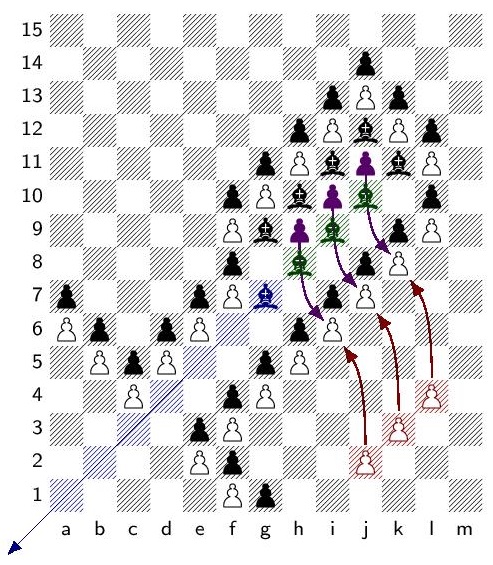
My example proceeds from the following (rather silly) position, with black to move. (White pawns move upward.)

Of course, Black should play the winning move: knight to C7, as shown here:

This places the white king in check, and there is nothing to be done about it, and so it is checkmate. Black has won, according to the usual chess rules of today.

But let us consider the position under the rules of simplified chess. Will Black be able to capture the white king? Well, after Black’s nC7, it is now White’s turn. Remember that in simplified chess, it is allowed (though inadvisable) to leave one’s king in check at the end of turn or even to move the king into check. But the trouble with this position is not that White can somehow move to avoid check, but rather simply that White has no moves at all. There are no White moves, not even moves that leave White in check. But therefore, in simplified chess, this position is a stalemate, rather than a Black win. In particular, Black will not actually be able to capture the White king, since White has no moves, and so the game will not proceed to that juncture.

Conclusion: checkmate in contemporary chess is not always the same thing as being necessarily able to capture the opposing king on the next move in simplified chess.

Of course, perhaps in simplified chess, one wouldn’t regard stalemate as a draw, but as a win for the player who placed the opponent in stalemate. That would be fine by me (and it would align with the rules currently used in draughts, where one loses when there is no move available), but it doesn’t negate my point. The position above would still be a Black win under that rule, sure, but still Black wouldn’t be able to capture the White king. That is, my claim would stand that checkmate (in modern rules) is not the same thing as the necessary possibility to capture the opposing king.

I had made a Tweet earlier today about this idea (below), but opted for a fuller explanation in this blog post to explain the idea more carefully.

On Twitter, user Gro-Tsen pointed out a similar situation arises with stalemates. Namely, consider the following position, with White to play:

Perhaps Black had just played qB5, which perhaps was a blunder, since now the White king sits in stalemate, with no move. So in the usual chess rules, this is a drawn position.

But in simplified chess, according to the rules I have described, the White king is not yet explicitly captured, and so he is free still to move around, to A6, A8, B6, or B7 (moving into check), or also capturing the black rook at B8. But in any case, whichever move White makes, Black will be able to capture the White king on the next move. So in the simplified chess rules, this position is White-to-win-in-1, and not a draw.

Furthermore, this position therefore shows once again that checkmate (in normal rules) is not the same as the necessary possibility to capture the king (in simplified rules), since this is a position where Black has a necessary possibility to capture the White king on the next move in simplified chess, but it is not checkmate in ordinary chess, being rather stalemate.

;TLDR Ultimately, my view is that our current rules of chess likely evolved from simplified rules and the idea that checkmate is what occurs when you have a necessary possibility of capturing the enemy king on the next move in those rules. But nevertheless, example chess positions show that these two notions are not quite exactly the same.
Fregean abstraction in set theory—a deflationary account, Italian Philosophy of Mathematics, September 2022

This will be a talk for the conference Philosophy of Mathematics: Foundations, Definitions and Axioms, the Fourth International Conference of the Italian Network for the Philosophy of Mathematics, 29 September to 1 October 2022.

Abstract. The standard set-theoretic distinction between sets and classes instantiates in important respects the Fregean distinction between objects and concepts, for in set theory we commonly take the universe of sets as a realm of objects to be considered under the guise of diverse concepts, the definable classes, each serving as a predicate on that domain of individuals. Although it is commonly held that in a very general manner, there can be no association of classes with objects in a way that fulfills Frege’s Basic Law V, nevertheless, in the ZF framework, it turns out that we can provide a completely deflationary account of this and other Fregean abstraction principles. Namely, there is a mapping of classes to objects, definable in set theory in senses I shall explain (hence deflationary), associating every first-order parametrically definable class $F$ with a set object $\varepsilon F$, in such a way that Basic Law V is fulfilled: $$\varepsilon F =\varepsilon G\iff\forall x\ (Fx\leftrightarrow Gx).$$ Russell’s elementary refutation of the general comprehension axiom, therefore, is improperly described as a refutation of Basic Law V itself, but rather refutes Basic Law V only when augmented with powerful class comprehension principles going strictly beyond ZF. The main result leads also to a proof of Tarski’s theorem on the nondefinability of truth as a corollary to Russell’s argument. A central goal of the project is to highlight the issue of definability and deflationism for the extension assignment problem at the core of Fregean abstraction.

Nonlinearity and illfoundedness in the hierarchy of consistency strength and the question of naturality, Italy (AILA), September 2022

This will be a talk for the meeting of The Italian Association for Logic and its Applications (AILA) in Caserta, Italy 12-15 September 2022.

Abstract. Set theorists and philosophers of mathematics often point to a mystery in the foundations of mathematics, namely, that our best and strongest mathematical theories seem to be linearly ordered and indeed well-ordered by consistency strength. Why should it be? The phenomenon is thought to carry profound significance for the philosophy of mathematics, perhaps pointing us toward the ultimately correct mathematical theories, the “one road upward.” And yet, we know as a purely formal matter that the hierarchy of consistency strength is not well-ordered. It is ill-founded, densely ordered, and nonlinear. The statements usually used to illustrate these features, however, are often dismissed as unnatural or as Gödelian trickery. In this talk, I aim to rebut that criticism by presenting a variety of natural hypotheses that reveal ill-foundedness in consistency strength, density in the hierarchy of consistency strength, and incomparability in consistency strength.

Set theory inside out: realizing every inner model theory in an end extension, European Set Theory Conference, September 2022

This will be a talk for the European Set Theory Conference 2022 in Turin, Italy 29 August – 2 September 2022.

Abstract. Every countable model of ZFC set theory with an inner model satisfying a sufficient theory must also have an end-extension satisfying that theory. For example, every countable model with a measurable cardinal has an end-extension to a model of $V=L[\mu]$; every model with extender-based large cardinals has an end-extension to a model of $V=L[\vec E]$; every model with infinitely many Woodin cardinals and a measurable above has an end-extension to a model of $\text{ZF}+\text{DC}+V=L(\mathbb{R})+\text{AD}$. These results generalize the famous Barwise extension theorem, of course, asserting that every countable model of ZF set theory admits an end-extension to a model of $\text{ZFC}+{V=L}$, a theorem which was simultaneously a technical culmination of Barwise’s pioneering methods in admissible set theory and infinitary logic and also one of those rare mathematical theorems that is saturated with philosophical significance. In this talk, I shall describe a new proof of the Barwise theorem that omits any need for infinitary logic and relies instead only on classical methods of descriptive set theory, while also providing the generalization I mentioned. This proof furthermore leads directly to the universal finite sequence, a $\Sigma_1$-definable finite sequence, which can be extended arbitrarily as desired in suitable end-extensions of the universe, a result holding important consequences for the nature of set-theoretic potentialism.  This work is joint with Kameryn J. Williams.
[bibtex key=”HamkinsWilliams2021:The-universal-finite-sequence”]

The ontology of mathematics, Japan Association for the Philosophy of Science, June 2022

I shall give the Invited Lecture for the Annual Meeting (online) of the Japanese Association for the Philosophy of Science, 18-19 June 2022.

Abstract. What is the nature of mathematical ontology—what does it mean to make existence assertions in mathematics? Is there an ideal mathematical realm, a mathematical universe, that those assertions are about? Perhaps there is more than one. Does every mathematical assertion ultimately have a definitive truth value? I shall lay out some of the back-and-forth in what is currently a vigorous debate taking place in the philosophy of set theory concerning pluralism in the set-theoretic foundations, concerning whether there is just one set-theoretic universe underlying our mathematical claims or whether there is a diversity of possible set-theoretic conceptions.

Infinite Games, Frivolities of the Gods, Logic at Large Lecture, May 2022

The Dutch Association for Logic and Philosophy of the Exact Sciences (VvL) has organized a major annual public online lecture series called LOGIC AT LARGE, where “well-known logicians give public audience talks to a wide audience,” and I am truly honored to have been invited to give this year’s lecture. This will be an online event, the second of the series, scheduled for May 31, 2022 (note change in date!), and further access details will be posted when they become available. Free registration can be made on the VvL Logic at Large web page.

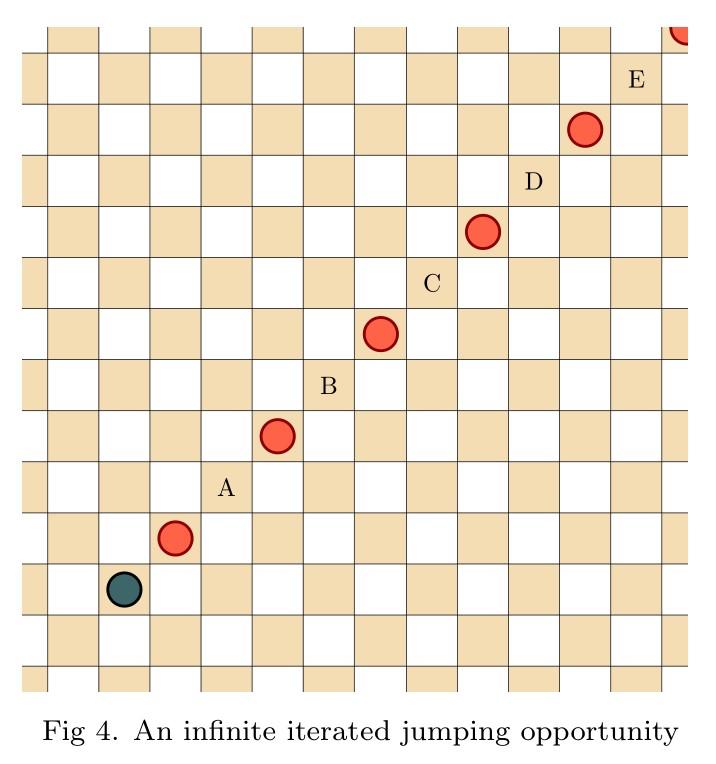
Abstract. Many familiar finite games admit natural infinitary analogues, which often highlight intriguing issues in infinite game theory. Shall we have a game of infinite chess? Or how about infinite draughts, infinite Hex, infinite Go, infinite Wordle, or infinite Sudoku? Let me introduce these games and use them to illustrate various fascinating concepts in the theory of infinite games.

Come enjoy the lecture, and stay for the online socializing event afterwards. Hope to see you there!

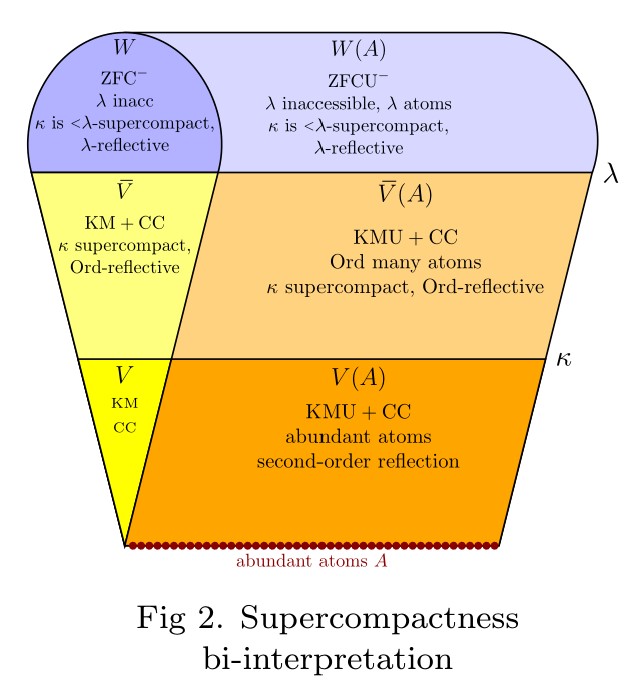
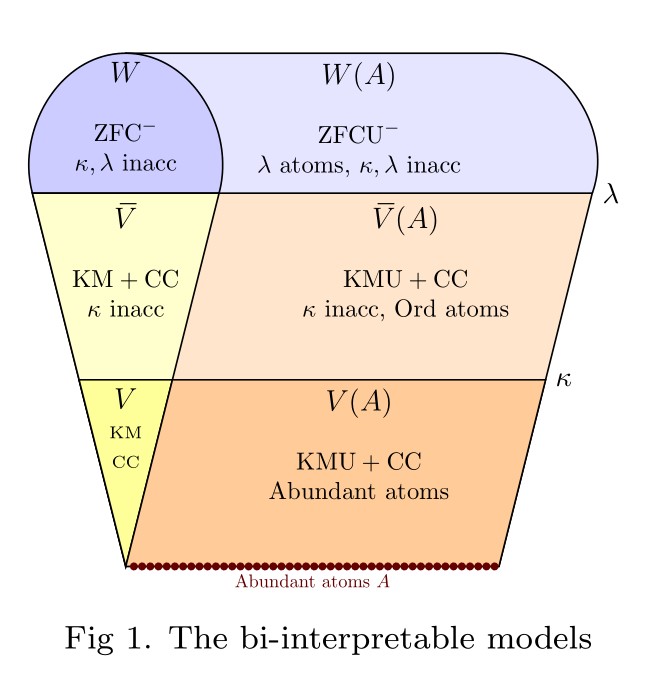
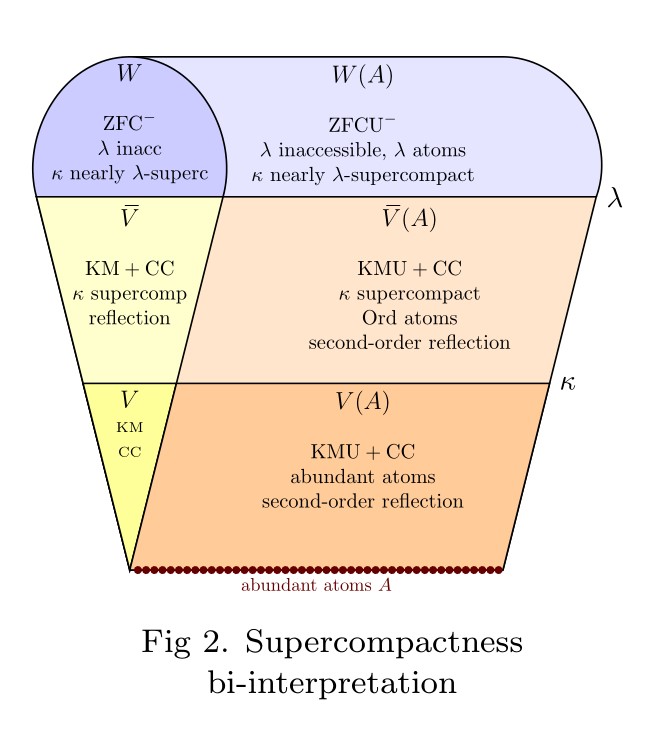
Reflection in second-order set theory with abundant urelements bi-interprets a supercompact cardinal

[bibtex key=”HamkinsYao:Reflection-in-second-order-set-theory-with-abundant-urelements”]

Download pdf at arXiv:2204.09766

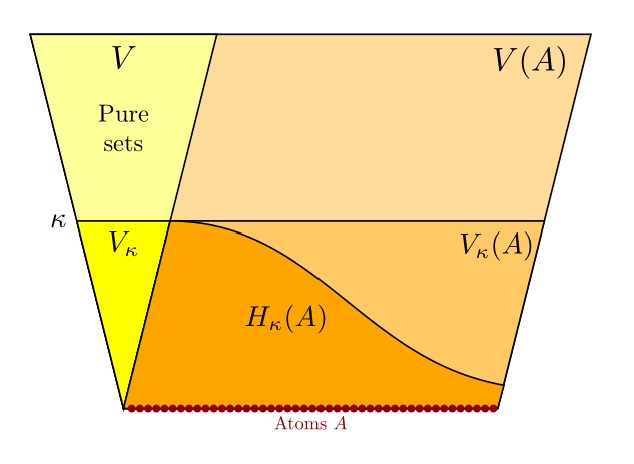
Abstract. After reviewing various natural bi-interpretations in urelement set theory, including second-order set theories with urelements, we explore the strength of second-order reflection in these contexts. Ultimately, we prove, second-order reflection with the abundant atom axiom is bi-interpretable and hence also equiconsistent with the existence of a supercompact cardinal. The proof relies on a reflection characterization of supercompactness, namely, a cardinal $\kappa$ is supercompact if and only if every $\Pi^1_1$ sentence true in a structure $M$ (of any size) containing $\kappa$ in a language of size less than $\kappa$ is also true in a substructure $m\prec M$ of size less than $\kappa$ with $m\cap\kappa\in\kappa$.

See also my talk at the CUNY Set Theory Seminar: The surprising strength of reflection in second-order set theory with abundant urelements

The surprising strength of reflection in second-order set theory with abundant urelements, CUNY Set Theory seminar, April 2022

This was an online talk 15 April 12:15 for the CUNY Set Theory Seminar. Held on Zoom at 876 9680 2366.

Abstract. I shall give a general introduction to urelement set theory and the role of the second-order reflection principle in second-order urelement set theory GBCU and KMU. With the abundant atom axiom, asserting that the class of urelements greatly exceeds the class of pure sets, the second-order reflection principle implies the existence of a supercompact cardinal in an interpreted model of ZFC. The proof uses a reflection characterization of supercompactness: a cardinal $\kappa$ is supercompact if and only if for every second-order sentence $\psi$ true in some structure $M$ (of any size) in a language of size less than $\kappa$ is also true in a first-order elementary substructure $m\prec M$ of size less than $\kappa$. This is joint work with Bokai Yao.

See the article at: Reflection in second-order set theory with abundant urelements bi-interprets a supercompact cardinal

Infinite Wordle and the Mastermind numbers

[bibtex key=”Hamkins:Infinite-Wordle-and-the-mastermind-numbers”]

Download article at arXiv:2203.06804

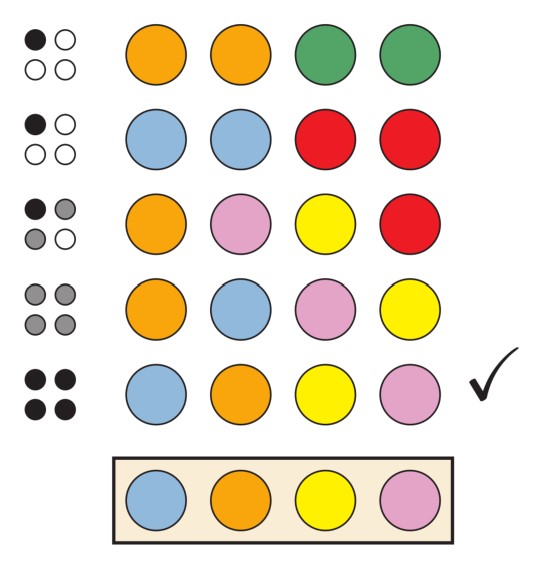
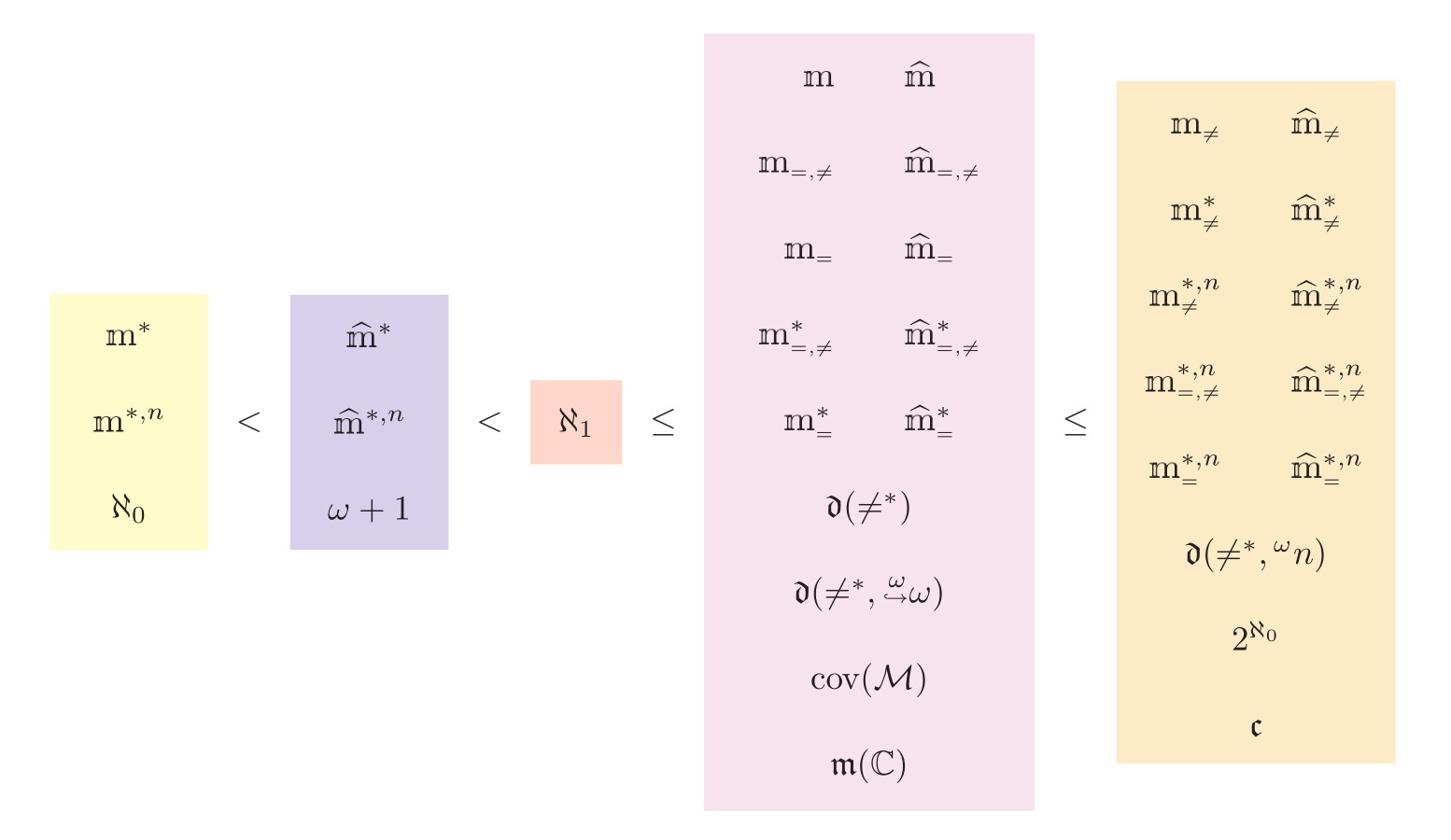
Abstract. I consider the natural infinitary variations of the games Wordle and Mastermind, as well as their game-theoretic variations Absurdle and Madstermind, considering these games with infinitely long words and infinite color sequences and allowing transfinite game play. For each game, a secret codeword is hidden, which the codebreaker attempts to discover by making a series of guesses and receiving feedback as to their accuracy. In Wordle with words of any size from a finite alphabet of $n$ letters, including infinite words or even uncountable words, the codebreaker can nevertheless always win in $n$ steps. Meanwhile, the mastermind number 𝕞, defined as the smallest winning set of guesses in infinite Mastermind for sequences of length $\omega$ over a countable set of colors without duplication, is uncountable, but the exact value turns out to be independent of ZFC, for it is provably equal to the eventually different number $\frak{d}({\neq^*})$, which is the same as the covering number of the meager ideal $\text{cov}(\mathcal{M})$. I thus place all the various mastermind numbers, defined for the natural variations of the game, into the hierarchy of cardinal characteristics of the continuum.

Infinite Wordle and the mastermind numbers, CUNY Logic Workshop, March 2022

This will be an in-person talk for the CUNY Logic Workshop at the Graduate Center of the City University of New York on 11 March 2022.

Abstract. I shall introduce and consider the natural infinitary variations of Wordle, Absurdle, and Mastermind. Infinite Wordle extends the familiar finite game to infinite words and transfinite play—the code-breaker aims to discover a hidden codeword selected from a dictionary $\Delta\subseteq\Sigma^\omega$ of infinite words over a countable alphabet $\Sigma$ by making a sequence of successive guesswords, receiving feedback after each guess concerning its accuracy. For any dictionary using the usual 26-letter alphabet, for example, the code-breaker can win in at most 26 guesses, and more generally in $n$ guesses for alphabets of finite size $n$. Meanwhile, for some dictionaries on an infinite alphabet, infinite play is required, but the code-breaker can always win by stage $\omega$ on a countable alphabet, for any fixed dictionary. Infinite Mastermind, in contrast, is a subtler game than Wordle because only the number and not the position of correct bits is given. When duplication of colors is allowed, nevertheless, the code-breaker can still always win by stage $\omega$, but in the no-duplication variation, no countable number of guesses (even transfinite) is sufficient for the code-breaker to win. I therefore introduce the mastermind number, denoted $\frak{mm}$, defined to be the size of the smallest winning no-duplication Mastermind guessing set, a new cardinal characteristic of the continuum, which I prove is bounded below by the additivity number $\text{add}(\mathcal{M})$ of the meager ideal and bounded above by the covering number $\text{cov}(\mathcal{M})$. In particular, the precise value of the mastermind number is independent of ZFC and can consistently be strictly between $\aleph_1$ and the continuum $2^{\aleph_0}$. In simplified Mastermind, where the feedback given at each stage includes only the numbers of correct and incorrect bits (omitting information about rearrangements), then the corresponding simplified mastermind number is exactly the eventually different number $\frak{d}(\neq^*)$.

I am preparing an article on the topic, which will be available soon.

Pluralism in the ontology of mathematics, MaMuPhi, Paris, February 2022

This will be a talk for the conference L’indépendance mathématique et ses limites logiques, an instance of the MAMUPHI seminar (mathématiques – musique – philosophie), organized by Mirna Džamonja, 12 February 2022. Most talks will be in-person in Paris, but my talk will be on Zoom via https://u-pec-fr.zoom.us/j/86448599486 at 4:30 pm CET (10:30 am EST).


Abstract: What is the nature of mathematical ontology—what does it mean to make existence assertions in mathematics? Is there an ideal mathematical realm, a mathematical universe, that those assertions are about? Perhaps there is more than one. Does every mathematical assertion ultimately have a definitive truth value? I shall lay out some of the back-and-forth in what is currently a vigorous debate taking place in the philosophy of set theory concerning pluralism in the set-theoretic foundations, concerning whether there is just one set-theoretic universe underlying our mathematical claims or whether there is a diversity of possible set-theoretic conceptions.

Infinite Hex is a draw

[bibtex key=”HamkinsLeonessi:Infinite-Hex-is-a-draw”]

Download the article at https://arxiv.org/abs/2201.06475.

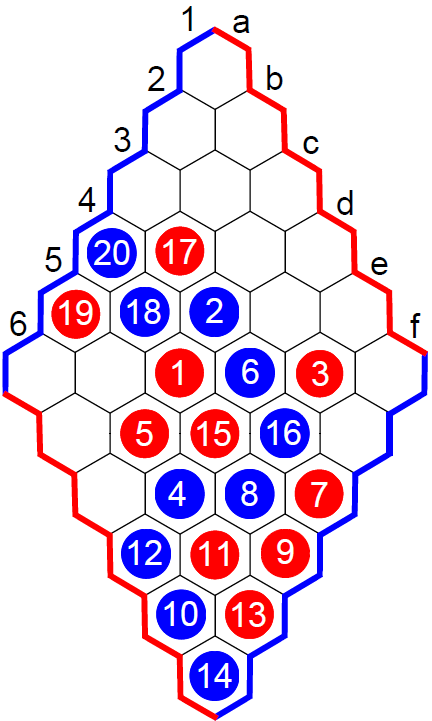
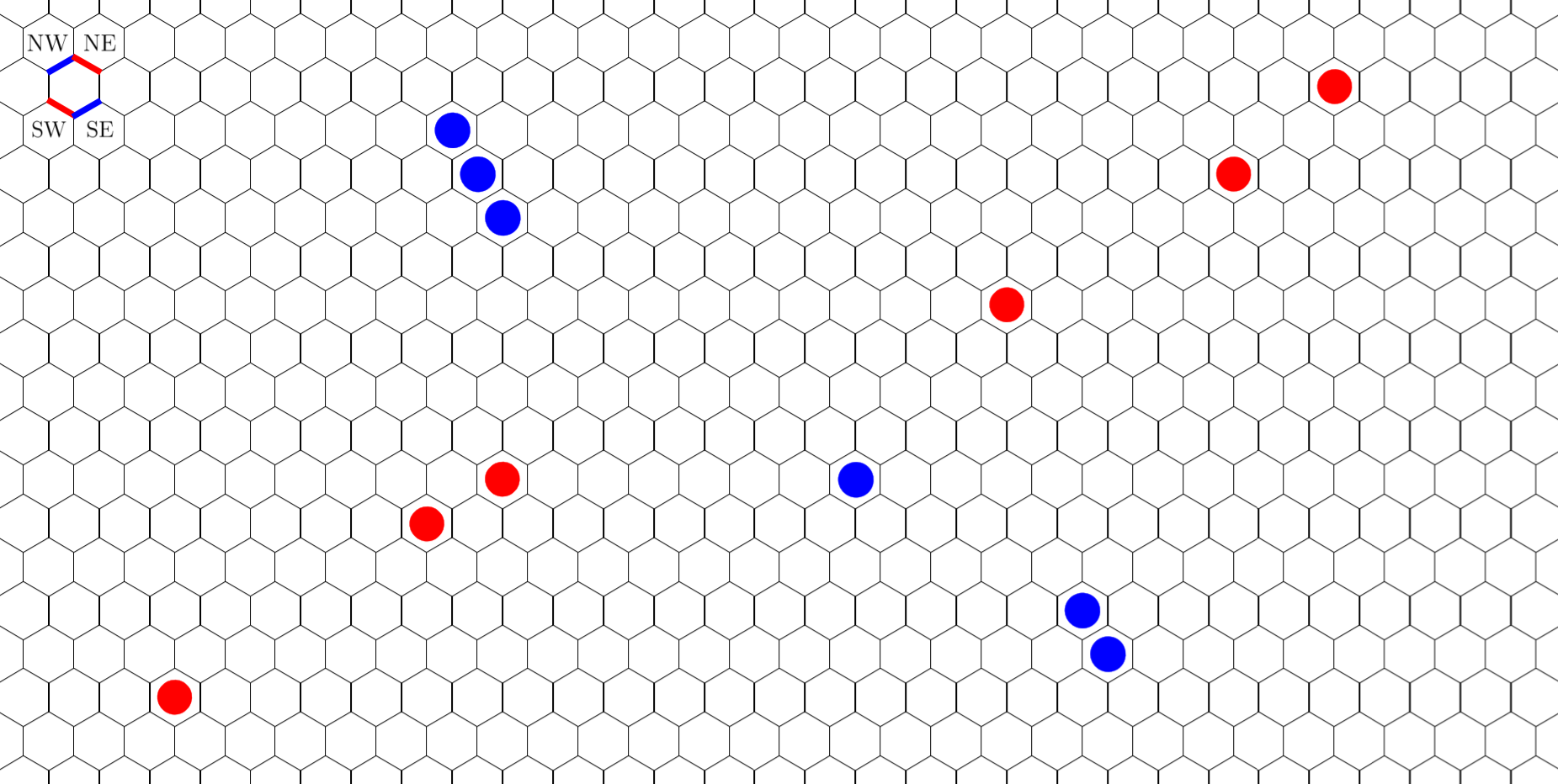
Abstract. We introduce the game of infinite Hex, extending the familiar finite game to natural play on the infinite hexagonal lattice. Whereas the finite game is a win for the first player, we prove in contrast that infinite Hex is a draw—both players have drawing strategies. Meanwhile, the transfinite game-value phenomenon, now abundantly exhibited in infinite chess and infinite draughts, regrettably does not arise in infinite Hex; only finite game values occur. Indeed, every game-valued position in infinite Hex is intrinsically local, meaning that winning play depends only on a fixed finite region of the board. This latter fact is proved under very general hypotheses, establishing the conclusion for all simple stone-placing games.

This is my second joint project with Davide Leonessi, the first being our work on Transfinite games values in infinite draughts, both projects growing out of his work on his MSc in MFoCS at Oxford, for which he earned a distinction in September 2021.

Here is a convenient online Hex player, for those who want to improve their game: http://www.lutanho.net/play/hex.html.

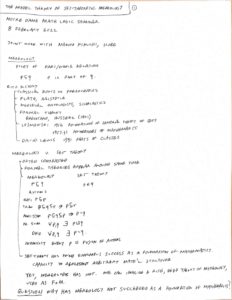
The model theory of set-theoretic mereology, Notre Dame Math Logic Seminar, February 2022

This will be a talk for the Mathematical Logic Seminar at the University of Notre Dame on 8 February 2022 at 2 pm in 125 Hayes Healy.

Abstract. Mereology, the study of the relation of part to whole, is often contrasted with set theory and its membership relation, the relation of element to set. Whereas set theory has found comparative success in the foundation of mathematics, since the time of Cantor, Zermelo and Hilbert, mereology is strangely absent. Can a set-theoretic mereology, based upon the set-theoretic inclusion relation ⊆ rather than the element-of relation ∈, serve as a foundation of mathematics? How well is a model of set theory ⟨M,∈⟩ captured by its mereological reduct ⟨M,⊆⟩? In short, how much set theory does set-theoretic mereology know? In this talk, I shall present results on the model theory of set-theoretic mereology that lead broadly to negative answers to these questions and explain why mereology has not been successful as a foundation of mathematics. (Joint work with Makoto Kikuchi)

Handwritten lecture notes

See the research papers:

Notre Dame campus in snow

Bi-interpretation in set theory, Oberwolfach Set Theory Conference, January 2022

This was a talk for the 2022 Set Theory Conference at Oberwolfach, which was a hybrid of in-person talks and online talks on account of the Covid pandemic. I gave my talk online 10 January 2022.

Abstract: Set theory exhibits a truly robust mutual interpretability phenomenon: in any model of one set theory we can define models of diverse other set theories and vice versa. In any model of ZFC, we can define models of ZFC + GCH and also of ZFC + ¬CH and so on in hundreds of cases. And yet, it turns out, in no instance do these mutual interpretations rise to the level of bi-interpretation. Ali Enayat proved that distinct theories extending ZF are never bi-interpretable, and models of ZF are bi-interpretable only when they are isomorphic. So there is no nontrivial bi-interpretation phenomenon in set theory at the level of ZF or above.  Nevertheless, for natural weaker set theories, we prove, including ZFC- without power set and Zermelo set theory Z, there are nontrivial instances of bi-interpretation. Specifically, there are well-founded models of ZFC- that are bi-interpretable, but not isomorphic—even $\langle H_{\omega_1},\in\rangle$ and $\langle H_{\omega_2},\in\rangle$ can be bi-interpretable—and there are distinct bi-interpretable theories extending ZFC-. Similarly, using a construction of Mathias, we prove that every model of ZF is bi-interpretable with a model of Zermelo set theory in which the replacement axiom fails. This is joint work with Alfredo Roque Freire.

Philosophy of Mathematics, Notre Dame Spring 2022

Philosophy of Mathematics
43906 01 (31349)

43906 02 (32481) – Reserved for Glynn Honors Program
Joel David Hamkins, Professor of Philosophy and Mathematics
3:30-4:45 TR, DeBartolo Hall 301
Cross-listed with MATH 40920 01

This series of self-contained seminar lectures on the philosophy of mathematics is intended for students in philosophy and mathematics. The lectures will be organized loosely around mathematical themes, in such a way that brings various philosophical issues naturally to light.